Herbert Macaulay Biography: Early Life, Death, Personal Life, Family, Education, Career, Awards, Philosophy, Achievements, Legacy, Net Worth
Herbert Macaulay Biography
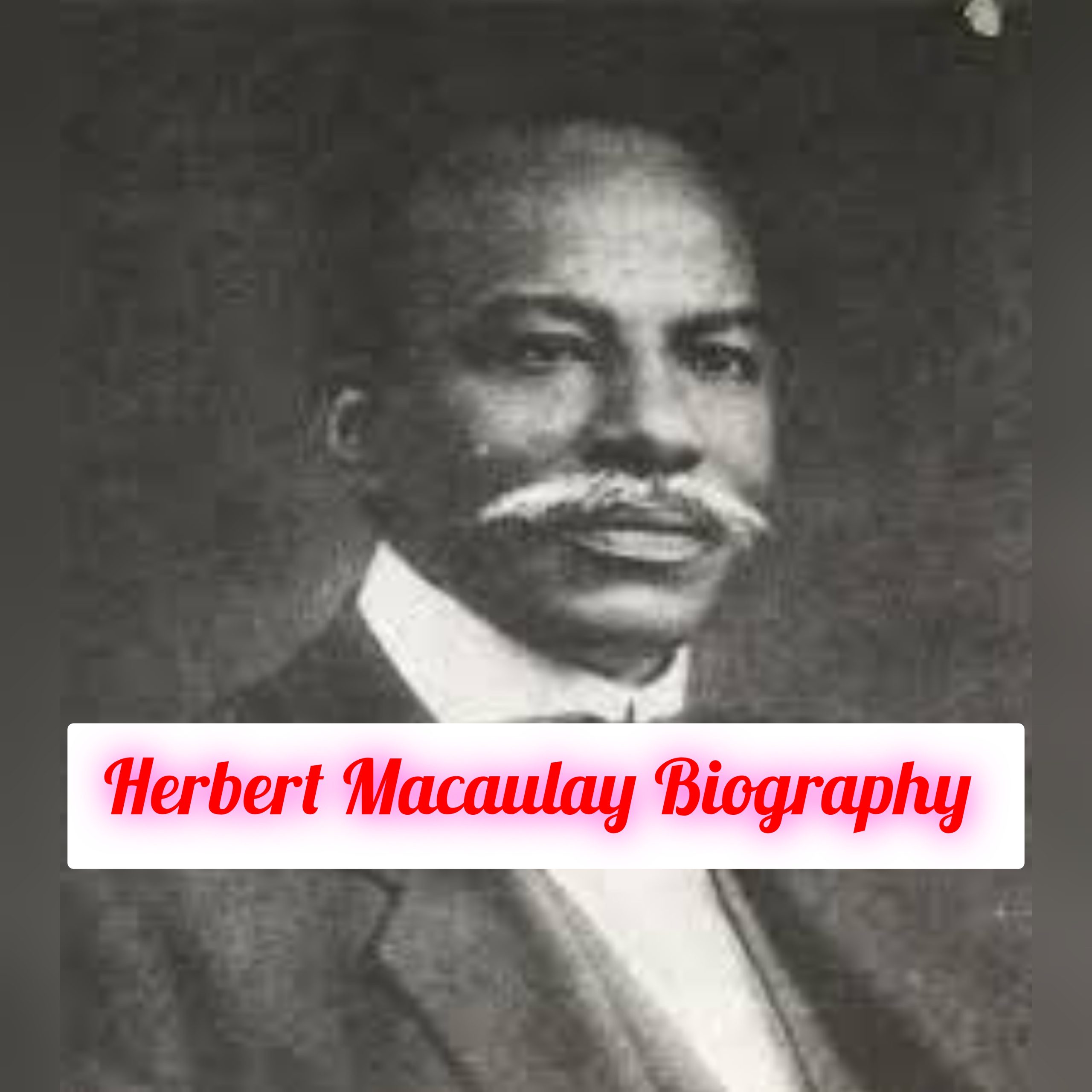
Herbert Macaulay stands as one of the most influential figures in the political awakening of modern Nigeria. As a civil engineer, surveyor, journalist, musician, and organiser, he challenged colonial authority through the courts, the press, and the first organised political party in the country. His work helped shift public thinking from passive acceptance of foreign rule toward organised demands for representation and self-government.
Born into a prominent Lagos family with deep ties to missionary education and Yoruba history, Macaulay combined technical skill with a fierce commitment to African rights. His long public career spanned the late nineteenth century and the first half of the twentieth, laying practical foundations that later nationalists built upon.
Olayinka Herbert Samuel Heelas Badmus Macaulay was born in Lagos and was Nigerian by nationality.
Herbert Macaulay Early Life
Herbert Macaulay was born on 14 November 1864 on Broad Street in Lagos, then a British colony on the West African coast. His parents belonged to the educated Saro community of returnees from Sierra Leone, people whose families had been liberated from the slave trade and later resettled in Nigeria. His father, Reverend Thomas Babington Macaulay, was an Anglican clergyman and educator who founded the Church Missionary Society Grammar School in Lagos, the first secondary school in what would become Nigeria. His mother, Abigail Crowther, was the daughter of Bishop Samuel Ajayi Crowther, the first African bishop of the Anglican Church and a figure of lasting importance in the region’s religious and educational history. Through his maternal line, Macaulay was also linked to the royal house of the old Oyo Empire.
Lagos in the 1860s and 1870s was a place of rapid change. The British had annexed the island in 1861, and the town mixed Yoruba traditions, Christian missionary influence, and the commercial energy of returning freed people from Sierra Leone and Brazil. Young Herbert grew up speaking Yoruba at home while receiving a formal English-style education. He began primary schooling around 1869 and later attended St Paul’s Breadfruit School and CMS Faji School. From 1877 to 1880 he studied at the CMS Grammar School founded by his father. His father died in 1878 while Herbert was still a student there.
In 1880, after leaving school, he joined a trade and missionary journey with a maternal uncle, travelling by steamer along the Niger River and visiting places such as Bonny, Lokoja, Gbebe, and Brass. The experience broadened his understanding of the wider Nigerian hinterland beyond the coastal colony. In September 1881 he entered the colonial civil service as a clerical assistant in the Lagos Public Works Department. His aptitude for mathematics and technical work soon became clear.
Herbert Macaulay Personal Life
In December 1898 Macaulay married Caroline Pratt, the daughter of an African superintendent of police. The marriage lasted less than a year. Caroline died in August 1899 during childbirth, and the infant did not survive. Deeply affected, Macaulay is reported to have vowed never to remarry in church. He kept a black bow tie and his distinctive moustache for the rest of his life as a mark of mourning.
Although he never remarried formally, he had relationships with several women and fathered a number of children. One long association was with Stella Davies Coker, daughter of J. P. L. Davies and Sarah Forbes Bonetta. They lived together from 1909 until her death in 1916 and had a daughter, Sarah Abigail Idowu Macaulay Adadevoh. Other children included Oliver Ogedengbe Macaulay, Frank Montague Macaulay, Helena Victoria Maria Macaulay Smith, Enitan Macaulay, Florence Macaulay, Tokunbo Macaulay, and Samuel Macaulay. Estimates of the total number of children vary, with some accounts placing the figure around sixteen.
Macaulay lived at a house known as Kirsten Hall on Balbina Street in Yaba, named after a German consul friend. The residence became a lively social centre. He organised concerts, film shows, and gatherings that brought together Lagos society. He was among the first Nigerians to own a motor car. Though raised in a devout Anglican family, he later took an interest in indigenous Yoruba religious practices, consulting diviners and keeping notes on traditional observances. He was known as a skilled violinist and a sociable figure who moved easily among different circles in colonial Lagos.
Herbert Macaulay Age
Herbert Macaulay lived to the age of 81. Born on 14 November 1864, he died on 7 May 1946 in Lagos. His long life allowed him to witness and shape the transition from early colonial administration to the organised nationalist politics of the 1940s.
Herbert Macaulay Education
Macaulay’s formal education began in Lagos mission schools. After primary studies he attended the CMS Grammar School from 1877 until 1880. In July 1890 the colonial government awarded him a scholarship to train in England. He studied civil engineering, surveying, and architecture in Plymouth under G. D. Bellamy, a borough surveyor and water engineer. He also spent time at Truro in Cornwall. In 1893 he qualified as a civil engineer, becoming the first Nigerian to achieve that professional status. He was admitted as a member of the Institution of Civil Engineers, the Royal Institute of British Architects, and later as a Fellow of the Royal Geographical Society.
While in Britain he also pursued music. He obtained a certificate from Trinity College of Music in London and another in violin playing from the Music International College. These studies complemented his technical training and remained a personal interest throughout his life. He returned to Lagos in September 1893 fully qualified for professional work.
Herbert Macaulay Career
Government Service and Private Practice
Upon returning from England, Macaulay was appointed Surveyor of Crown Lands for the Colony of Lagos. He held the post until September 1898. During these years he carried out official surveys and valuations. Growing dissatisfaction with racial discrimination in the civil service, including lower pay and limited promotion opportunities for Africans, led him to resign. He obtained a private licence to practise as a surveyor and architect. In private practice he prepared plans and valuations for notable Lagos residences, including houses belonging to E. J. Alex Taylor, Henry Carr, Akinola Maja, and the Doherty family.
Journalism and Public Advocacy
From the early 1900s Macaulay used the press to criticise colonial policy. He contributed articles to existing newspapers and later helped acquire and direct the Lagos Daily News, one of the first daily papers in British West Africa. Through its pages he exposed financial irregularities in the railway administration, opposed water rates imposed without adequate African representation, and defended traditional land rights. His writing was sharp and persistent. Colonial officials regarded the paper as a constant source of opposition. He was sued for libel on several occasions and in 1928 served a six-month prison sentence related to sedition charges arising from his political activities.
Legal Campaigns and Traditional Authority
Macaulay advised and supported traditional leaders in major land disputes. The most significant was the Apapa land case involving Chief Amodu Tijani, the Oluwa of Lagos. After losing in local courts, the chief appealed to the Judicial Committee of the Privy Council in London. Macaulay travelled with him as private secretary and helped present the case. In 1921 the Privy Council ruled in favour of the chief, affirming that traditional owners held title and were entitled to compensation. The victory strengthened Macaulay’s reputation among ordinary Lagosians and traditional rulers. He also supported the Eleko of Lagos, Eshugbayi Eleko, in disputes with the colonial government over recognition and authority, campaigns that lasted into the early 1930s.
Political Organisation
On 24 June 1923 Macaulay founded the Nigerian National Democratic Party, the first modern political party in Nigeria. The party contested the limited elective seats created by the Clifford Constitution of 1922 for the Legislative Council in Lagos. Its platform called for greater self-government for Lagos, the expansion of higher education, compulsory primary schooling, Africanisation of the civil service, and equal opportunities in economic enterprise. The NNDP won all available Lagos seats in the elections of 1923, 1928, and 1933, dominating local politics for more than a decade. Macaulay relied on alliances with market women, traditional chiefs, and ordinary residents to build support.
In 1944, at the age of nearly eighty, he joined with Nnamdi Azikiwe and others to form the National Council of Nigeria and the Cameroons. He was elected its first president. The organisation sought to unite diverse groups across the country in the demand for independence. In 1945 and early 1946 he took part in a national tour to build the new movement. He fell ill in Kano and was brought back to Lagos, where he died on 7 May 1946. His reported last words urged the National Council delegates to continue their work and asked his son Oged to keep the flag flying.
Herbert Macaulay Family
Macaulay’s immediate family was rooted in the missionary and educational elite of nineteenth-century Lagos. His father founded Nigeria’s first secondary school. His maternal grandfather, Bishop Samuel Ajayi Crowther, was a central figure in the Anglican mission and a symbol of African achievement within the church. Macaulay himself became the head of a large extended household. After the early death of his wife Caroline Pratt, he raised children with several partners. His son Oliver Ogedengbe Macaulay later became active in politics and the Zikist movement. A grandson, Babatunde Kwaku Adadevoh, served as vice-chancellor of the University of Lagos. A great-granddaughter, Dr Stella Ameyo Adadevoh, became known for her role during the 2014 Ebola outbreak in Nigeria. The family remained connected to public life long after Macaulay’s death.
Herbert Macaulay Philosophy
Macaulay’s thinking centred on the dignity and rights of Africans under colonial rule. He rejected the claim that British administrators governed solely in the true interests of the natives. In one memorable phrase he wrote that those interests were equal to the length, breadth, and depth of the white man’s pocket. He believed Africans should control their own land, participate fully in government, and develop their own educational and economic institutions. Early in his career he focused on reform and representation rather than immediate independence. He used British law and British institutions against colonial excesses, showing that Africans could master the system that ruled them. Later he recognised the need for a broader national movement that reached beyond Lagos. His philosophy combined respect for traditional authority with modern political organisation and a strong faith in the power of the press and public opinion.
Herbert Macaulay Achievements
Macaulay’s most lasting achievements were institutional. He became the first Nigerian qualified as a civil engineer and practised successfully as a surveyor and architect. He founded the Nigerian National Democratic Party in 1923, creating the first structured political party in the country and demonstrating that Africans could organise and win elections even under restricted franchise. He played a central role in the successful Privy Council appeal that protected traditional land rights in Lagos. Through journalism he built a sustained public critique of colonial policy that educated ordinary people about their rights. In 1944 he helped establish the National Council of Nigeria and the Cameroons, the first truly national nationalist organisation, and served as its president. These steps created the organisational and intellectual groundwork for the independence movement that succeeded in 1960.
Herbert Macaulay Awards
No formal colonial medals or British honours are recorded for Macaulay, consistent with his long opposition to the administration. After independence, Nigeria recognised his contribution in several lasting ways. His portrait appeared on the one-naira banknote issued in the 1970s and later on the one-naira coin. A postage stamp was issued in 1964 marking him as a champion of independence. The Herbert Macaulay Library in Yaba, Lagos, carries his name. Streets in Lagos and Abuja are named after him, and a Nigerian shipping vessel was christened the Herbert Macaulay in 1972. A statue stands on Herbert Macaulay Street in Yaba. These public commemorations reflect the high regard in which later generations held his pioneering role.
Herbert Macaulay Legacy
Macaulay’s influence extended beyond his lifetime. The political party he founded and the national council he led provided models for later organisations. His use of the courts, the press, and alliances with traditional rulers and market women showed practical methods of resistance that others adapted. Although his base remained strongest in Lagos, the national tour of the NCNC in 1945 and 1946 signalled the shift toward a countrywide movement. Historians continue to examine both his achievements and the controversies that surrounded him, including legal convictions that barred him from elective office and allegations related to his earlier government service. The overall assessment remains that he was among the earliest and most effective organisers of Nigerian nationalism.
Conclusion
Herbert Macaulay lived through the formative decades of colonial rule in Nigeria and refused to accept its permanence. From his technical training in England to his private practice, from newspaper columns to the founding of political parties, he consistently argued that Africans possessed the capacity and the right to shape their own affairs. He did not live to see independence in 1960, yet the institutions and habits of organised politics he established helped make that independence possible. His life remains a clear example of determined public service grounded in professional skill, legal knowledge, and a deep attachment to the people of Lagos and the wider Nigerian territory.
FAQs
Who was Herbert Macaulay?
Herbert Macaulay was a Nigerian civil engineer, surveyor, journalist, musician, and political organiser who is widely regarded as the father of Nigerian nationalism. He founded the first political party in Nigeria and later served as the first president of the National Council of Nigeria and the Cameroons.
When and where was Herbert Macaulay born?
He was born on 14 November 1864 on Broad Street in Lagos, then a British colony.
What was Herbert Macaulay’s full name?
His full name was Olayinka Herbert Samuel Heelas Badmus Macaulay.
What did Herbert Macaulay achieve in his career?
He became the first Nigerian qualified civil engineer, practised as a surveyor and architect, founded the Nigerian National Democratic Party in 1923, helped win a major land rights case at the Privy Council, directed an influential newspaper, and co-founded the National Council of Nigeria and the Cameroons, serving as its president.
Did Herbert Macaulay have a family?
He married Caroline Pratt in 1898; she died the following year. He later had several children with other partners, including Oliver Ogedengbe Macaulay and Sarah Abigail Idowu Macaulay Adadevoh. Descendants include the late university administrator Babatunde Kwaku Adadevoh and the physician Stella Ameyo Adadevoh.
When did Herbert Macaulay die?
He died on 7 May 1946 in Lagos at the age of 81 after falling ill during a political tour in northern Nigeria.
Why is Herbert Macaulay called the father of Nigerian nationalism?
He organised the first political party in the country, used the courts and the press to challenge colonial policy over several decades, and helped create the first national political organisation that brought together people from different regions in the demand for self-government.