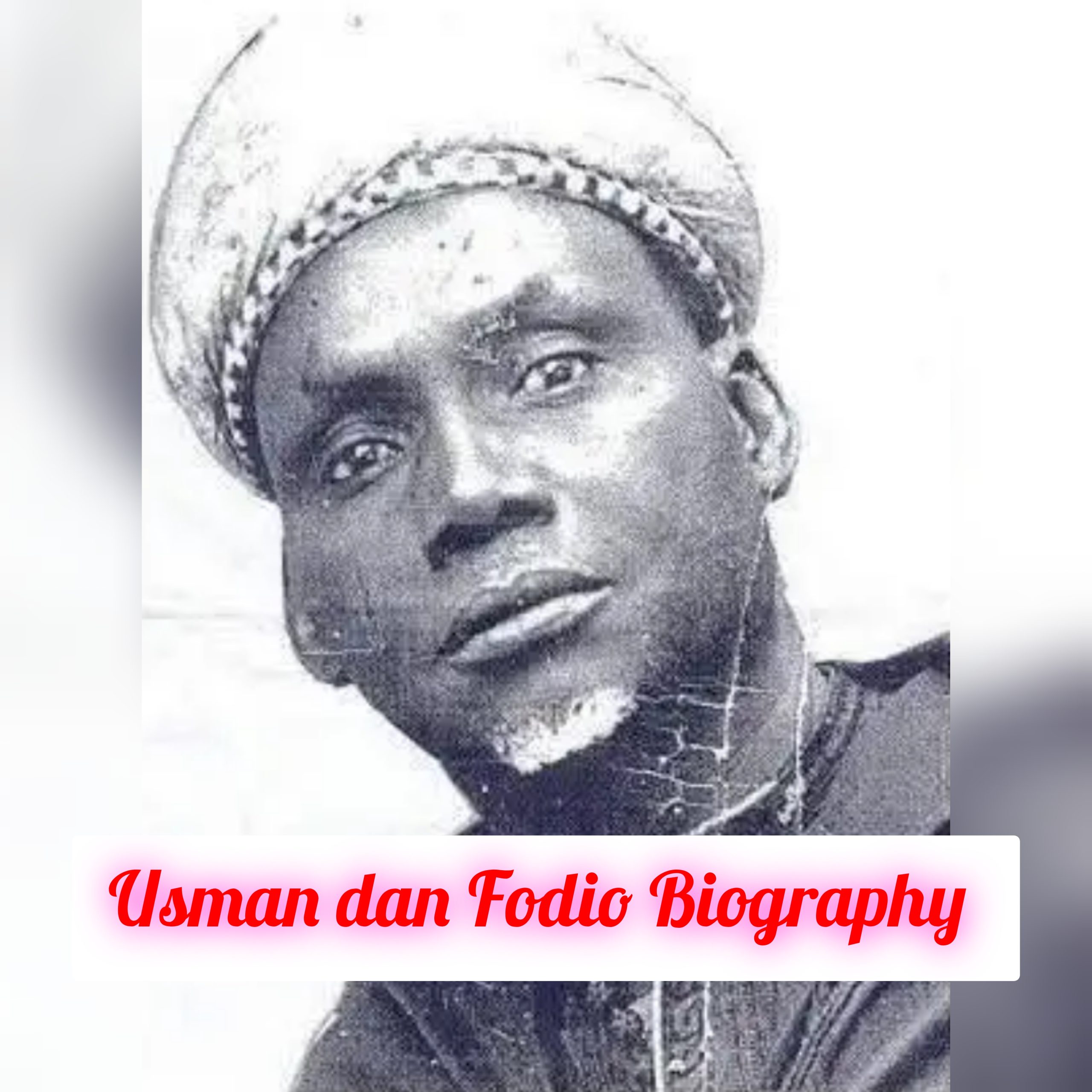
Usman dan Fodio Biography: Early Life, Personal Life, Age, Family, Education, Career, Awards, Philosophy, Achievements, Legacy, Death, Net Worth
Usman dan Fodio Biography
Usman dan Fodio stands as one of the most influential figures in the history of West African Islam. As a scholar, teacher, poet, and reformer, he led a movement that transformed the religious, political, and social landscape of the Hausa states in the early nineteenth century. His efforts produced the Sokoto Caliphate, one of the largest and most enduring Islamic states in sub-Saharan Africa before the colonial era.
His life combined deep spiritual commitment with practical leadership. Through decades of teaching and writing, he challenged practices he viewed as contrary to Islamic principles and inspired a broad following that eventually reshaped governance across a vast region. The institutions and intellectual traditions he fostered continue to influence northern Nigeria and surrounding areas to this day.
Usman dan Fodio was born in Maratta, in the Hausa state of Gobir (now in northwestern Nigeria), and was of Fulani nationality within the broader West African cultural sphere.
Usman dan Fodio Early Life
Usman dan Fodio was born on 15 December 1754 in the village of Maratta, located in the Hausa kingdom of Gobir in what is today northwestern Nigeria. Some accounts place the site near the present border with Niger. His family belonged to the Toronkawa clan of the Fulani people, a group of scholars and pastoralists who had migrated from Futa Toro in the Senegal region centuries earlier and settled in Hausaland around the fifteenth century.
His father, Muhammad Fodio (also known as Muhammad Fodiye), was a respected Islamic scholar whose title “Fodio” or “Fodiye” meant “the learned” in Fulfulde. His mother, Hauwa bint Muhammad, came from a scholarly lineage and provided early instruction to her children. The family soon moved south to Degel, where young Usman began his formal study of the Quran under his father’s guidance. The household environment emphasized learning, piety, and the transmission of Islamic knowledge across generations.
Growing up in Gobir during a period of political tension among the Hausa city-states, Usman observed the coexistence of nominal Islam with local customs. These observations later shaped his reformist outlook. From an early age he showed aptitude for religious study and a disciplined character that impressed those around him.
Usman dan Fodio Personal Life
Usman dan Fodio lived a life marked by simplicity and devotion to scholarship and teaching. Contemporary descriptions portray him as tall and lean, resembling his mother in appearance. He maintained a modest lifestyle even after becoming the leader of a large political entity, preferring study and writing over ceremonial display.
He followed the Maliki school of Islamic jurisprudence and belonged to the Qadiriyya Sufi order. Mystical experiences, including visions, played a role in his spiritual development and reinforced his sense of mission. He avoided unnecessary entanglement with royal courts for much of his early career, though he occasionally interacted with rulers when it served the interests of the Muslim community.
His daily routine centered on teaching, composition of religious works, and guidance of followers. After the major military campaigns of the jihad, he largely withdrew from direct administration, entrusting practical governance to close relatives while continuing to teach and write until his final years.
Usman dan Fodio Age
Usman dan Fodio was born on 15 December 1754 and died on 20 April 1817 in Sokoto. He was sixty-two years old at the time of his death. He spent his final years in the city that became the capital of the state he founded, continuing his scholarly work until the end.
Usman dan Fodio Education
Usman dan Fodio received a thorough traditional Islamic education typical of scholarly Fulani families of the period. He first studied the Quran with his father in Degel. He then studied with various relatives and local scholars, including his uncle Uthman Binduri and Muhammad Sambo.
A formative influence was the teacher Jibril ibn Umar of Agadez, a reform-minded scholar known for strict views on Islamic practice. Under Jibril and others, Usman studied tafsir (Quranic interpretation), hadith, fiqh (jurisprudence), Arabic grammar, theology, mysticism (tasawwuf), and related disciplines. He also gained exposure to mathematics and astronomy as part of the broader scholarly curriculum.
By about the age of twenty he had established his own school in Degel. He combined teaching with continued study, following the itinerant scholarly tradition of the region. His education equipped him to write extensively in Arabic and to compose poetry in Fulfulde and Hausa, making complex ideas accessible to wider audiences.
Usman dan Fodio Career
Teaching and Preaching
Around 1774 Usman dan Fodio began his public career as an itinerant teacher and preacher. For roughly twelve years he traveled through Kebbi and Gobir, then spent additional years in Zamfara. He taught the fundamentals of Islam, urged moral reform, and criticized practices he regarded as innovations or syncretism, including unjust taxation, corruption, and the blending of pre-Islamic customs with Islamic observance.
His reputation grew steadily. He attracted students from diverse backgrounds, including rural communities and members of the scholarly class. Among those who studied with him was the future sultan Yunfa of Gobir. Usman secured limited concessions from Sultan Bawa of Gobir that allowed freer propagation of Islam. He established a community at Degel intended to serve as a model of Islamic life.
Rising Tensions and Migration
By the 1790s relations with the Gobir ruling house deteriorated. Successive rulers viewed the growing autonomous Muslim community as a political threat. Restrictive measures were imposed, including limits on preaching and conversion. After an attempt on his life and increasing pressure, Usman led his followers in a migration (hijra) to Gudu in February 1804, an event consciously modeled on the Prophet Muhammad’s migration from Mecca to Medina.
Leadership of the Jihad
At Gudu his followers proclaimed him Amir al-Mu’minin (Commander of the Faithful). He declared jihad against the Hausa rulers, whom he accused of failing to uphold Islamic law and of oppressing Muslims. The military campaigns that followed, lasting primarily from 1804 to 1808, were directed in the field by his brother Abdullahi and his son Muhammad Bello. Key victories included the battle of Tabkin Kwatto and the eventual fall of the Gobir capital Alkalawa in 1808.
The movement rapidly expanded beyond Gobir. Many Hausa states and neighboring territories came under the control of leaders who accepted Usman’s authority. By approximately 1809–1812 a new political order, later known as the Sokoto Caliphate, had taken shape. Usman served as its first caliph but increasingly focused on spiritual and intellectual leadership rather than day-to-day administration.
Later Years
After the main conquests, Usman largely retired from military affairs around 1811. He continued writing and teaching, providing guidance on governance, law, and religious practice. The caliphate was organized with dual administrative centers: Sokoto under Muhammad Bello in the east and Gwandu under Abdullahi in the west. Usman moved to Sokoto in his final years and died there in 1817.
Usman dan Fodio Family
Usman dan Fodio came from a large scholarly family. His younger brother Abdullahi dan Fodio (c. 1766–1829) was a close collaborator, military commander, scholar, and administrator who governed the western portion of the caliphate from Gwandu.
Usman married several wives in accordance with Islamic practice, commonly maintaining four at a time. Among the best documented were Maymuna (his first cousin), Aisha (also known as Iyya Garka or Gaabdo), Hauwa (Inna Garka), and Hadiza. He also had a concubine named Mariya. Sources indicate he had approximately twenty-three to thirty-seven children in total, though exact counts vary.
Notable children included Muhammad Bello (c. 1781–1837), who succeeded him as caliph and ruled from Sokoto; Abu Bakr Atiku; and the twin children born in 1793 to Maymuna: Hassan and Nana Asma’u (1793–1864). Nana Asma’u became a celebrated poet, teacher, and advocate of women’s education. She organized networks of female instructors known as the Yan Taru and left an extensive body of written work. Other daughters and sons also contributed to scholarship and administration within the caliphate.
The family as a whole formed an intellectual network that sustained the educational and literary culture of the Sokoto state for generations.
Usman dan Fodio Philosophy
Usman dan Fodio’s thought centered on the renewal (tajdid) of Islam and the establishment of a society governed by the Sharia according to the Maliki school. He identified himself with the tradition of the mujaddid, the renewer of the faith expected at the turn of each Islamic century.
A major theme in his teaching was the rejection of bid’a (blameworthy innovation) and the revival of the Sunnah. He criticized rulers and scholars who tolerated or participated in practices such as spirit worship, unjust taxation, forced labor, and the enslavement of free Muslims. He insisted that true Islamic governance required justice, accountability, and the protection of the vulnerable.
As a member of the Qadiriyya Sufi order, he integrated mystical practice with strict adherence to the Sharia. He distinguished between authentic Sufism, focused on ethical purification and closeness to God, and excesses that contradicted Islamic law. He composed works on the spiritual path while maintaining that outward observance and inward sincerity must remain united.
He placed strong emphasis on education for both men and women. He argued that neglecting the education of women left half of the community in ignorance and that women should receive the same foundational religious knowledge as men. This stance was reflected in the scholarly achievements of his own daughters and in the broader educational culture of the caliphate.
His political philosophy held that a Muslim community facing oppression by rulers who failed to apply Islamic law had the right, under certain conditions, to migrate and, if necessary, to resist. Once established, the ideal state should be administered by pious and learned officials rather than by hereditary privilege alone.
Usman dan Fodio Achievements
Usman dan Fodio’s most visible achievement was the foundation of the Sokoto Caliphate. Between 1804 and the early 1810s his movement unified the Hausa states under a single Islamic administration for the first time and extended influence into parts of present-day Niger, Cameroon, Burkina Faso, and beyond. The caliphate became one of the largest political entities in nineteenth-century West Africa and endured until the British conquest in the early twentieth century.
He produced a substantial body of written work. Scholars have identified more than one hundred titles attributed to him, covering theology, law, governance, ethics, Sufism, and social reform. Among the best known are Ihya’ al-Sunna wa Ikhmad al-Bid’a (The Revival of the Sunnah and the Extinction of Innovation) and Bayan Wujub al-Hijra (Exposition of the Obligation of Migration). He also composed numerous poems in Arabic, Fulfulde, and Hausa that circulated widely and helped disseminate his ideas.
His promotion of literacy and scholarship, including for women, strengthened intellectual life across the region. The administrative system of emirates under central spiritual authority provided a durable framework of governance rooted in Islamic legal principles. His example inspired subsequent reform movements elsewhere in West Africa, including those associated with Seku Amadu and Umar Tall.
Usman dan Fodio Awards
As a historical figure of the pre-colonial period, Usman dan Fodio did not receive modern formal awards. Within the Islamic scholarly tradition he was recognized with titles of high esteem. His followers addressed him as Shehu (the Hausa form of Shaykh). He was proclaimed Amir al-Mu’minin (Commander of the Faithful) and regarded by many as a mujaddid (renewer of the faith) and Nūr al-Zamān (Light of the Age). These designations reflected the respect he commanded among contemporaries and later generations rather than any institutional prize system.
Usman dan Fodio Legacy
The Sokoto Caliphate left a lasting imprint on the political culture of northern Nigeria. Its system of emirates, emphasis on Islamic learning, and use of Arabic and local languages for administration and literature shaped subsequent developments. Descendants of the ruling families and scholarly lineages associated with Usman dan Fodio continued to hold influence into the colonial and independence periods.
His writings remain studied in traditional Islamic schools and modern academic settings. The educational initiatives associated with his family, particularly those of Nana Asma’u, provided models of female scholarship that are still referenced today. The caliphate’s promotion of trade, relative security, and standardized legal practice contributed to economic and social integration across a wide territory.
At the same time, the jihad involved military conflict and the replacement of earlier political structures. Historians continue to examine both the reformist ideals and the practical consequences of the transformation he initiated.
Conclusion
Usman dan Fodio’s life illustrates the power of sustained scholarship combined with moral conviction. From a modest scholarly family in Gobir he rose to lead a movement that redefined the religious and political order of a large part of West Africa. His insistence on justice, education, and fidelity to Islamic sources produced institutions and texts that outlived him by generations.
The Sokoto Caliphate he founded demonstrated that a state grounded in religious principle could achieve both territorial expanse and intellectual vitality. His example continues to invite reflection on the relationship between faith, learning, and public life in African history.
FAQs
When was Usman dan Fodio born?
Usman dan Fodio was born on 15 December 1754 in Maratta, Gobir, in what is now northwestern Nigeria.
Where did Usman dan Fodio die?
He died on 20 April 1817 in Sokoto, the capital of the caliphate he founded.
What was the Sokoto Caliphate?
The Sokoto Caliphate was the large Islamic state established through the reform movement and military campaigns led by Usman dan Fodio between 1804 and the early 1810s. It unified the Hausa states and extended across parts of present-day northern Nigeria, Niger, Cameroon, and neighboring regions.
Who succeeded Usman dan Fodio?
His son Muhammad Bello succeeded him as caliph and ruled from Sokoto. His brother Abdullahi governed the western territories from Gwandu.
Did Usman dan Fodio support education for women?
Yes. He argued strongly for the education of women in Islamic knowledge and ensured that his own daughters received thorough instruction. His daughter Nana Asma’u became a prominent scholar and teacher.
How many books did Usman dan Fodio write?
Scholars have identified more than one hundred works attributed to him, covering theology, law, ethics, governance, and Sufism, along with numerous poems.
What was Usman dan Fodio’s main religious affiliation?
He was a Sunni Muslim of the Maliki school of jurisprudence and a member of the Qadiriyya Sufi order.