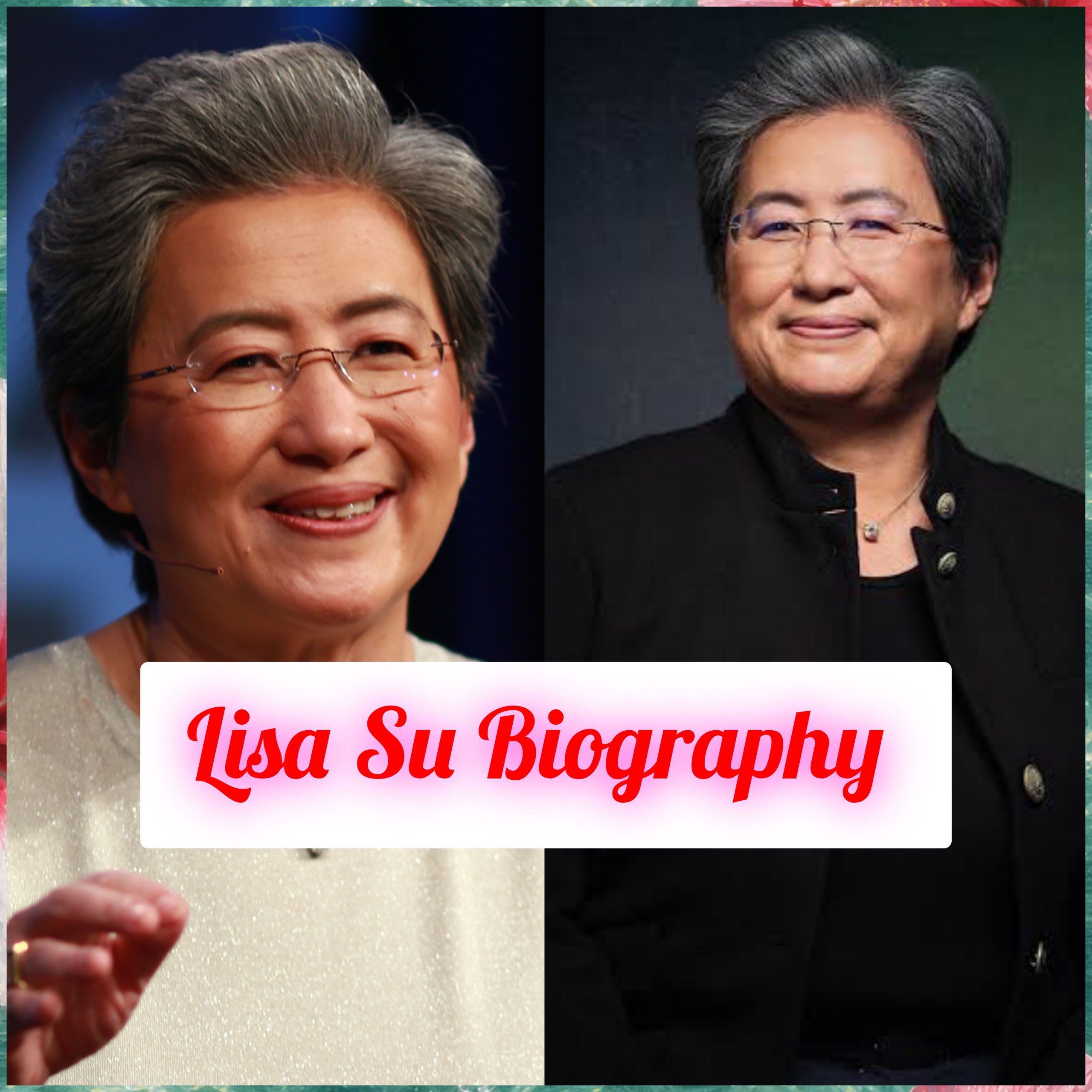
Lisa Su Biography: Early Life, Education, Personal Life, Family, Career, Achievements, Awards, Philosophy, Legacy, Net Worth
Lisa Su Biography
Lisa Su has shaped the modern semiconductor industry through a rare combination of deep technical expertise and decisive corporate leadership. As the chair and chief executive officer of Advanced Micro Devices, she guided the company from near collapse to a position of strength in high performance computing, graphics, and artificial intelligence. Her path from an immigrant childhood in New York to the highest levels of technology leadership reflects disciplined curiosity, rigorous engineering training, and a consistent willingness to tackle difficult technical and business challenges.
Her influence extends beyond a single company. Through product innovations, strategic acquisitions, and industry partnerships, she has helped redefine competition in computing hardware at a time when demand for advanced chips has accelerated rapidly. The following account traces her life and work with attention to verified facts drawn from public records and reliable reporting.
Lisa Tzwu-Fang Su was born in Tainan, Taiwan. She holds Taiwanese and American nationality.
Lisa Su Early Life
Lisa Tzwu-Fang Su was born on November 7, 1969, in Tainan, a coastal city in southwestern Taiwan. She came from a Taiwanese Hokkien speaking family. Her father, Su Chun hwai, worked as a statistician. Her mother, Sandy Lo, trained as an accountant and later pursued entrepreneurial work. The family emigrated to the United States when Lisa was three years old. Her father had gone ahead to pursue graduate studies, and the family eventually settled in the Queens borough of New York City.
Growing up in Queens, Su and her brother received strong encouragement to study mathematics and science. Her father began quizzing her on multiplication tables when she was seven. Her mother introduced practical ideas about business and problem solving. From an early age Su showed a strong interest in how mechanical and electronic devices functioned. By the age of ten she was taking apart and repairing her brother’s remote controlled cars. In junior high school she received her first personal computer, an Apple II, which further fueled her curiosity about technology.
Su attended the Bronx High School of Science, a selective public magnet school known for its rigorous science curriculum. She graduated in 1986. The combination of family emphasis on education, hands on tinkering, and a strong high school foundation prepared her for advanced study in engineering. She has described her childhood as one in which hard work and excellence were expected, and she has credited her parents’ example for shaping her approach to challenges.
Lisa Su Personal Life
Su maintains a private personal life away from the public attention that accompanies her professional role. She is married to Daniel Lin. The couple lives in Austin, Texas, where AMD has a significant presence. Public information about their life together is limited, consistent with Su’s preference for focusing interviews and public appearances on technical and business matters rather than private details.
Outside work she has spoken occasionally about maintaining physical fitness. After becoming chief executive she adopted a regular practice of boxing with a trainer. She has also referenced classical music and reading among personal interests, though these remain secondary to her professional commitments in available accounts. Su has emphasized that her public identity centers on the engineering and leadership work she performs rather than personal publicity.
Lisa Su Age
As of 2026 Lisa Su is 56 years old. She was born on November 7, 1969. Her professional career spans more than three decades, beginning with technical research roles in the mid 1990s and continuing through senior leadership positions into the present.
Lisa Su Education
After high school Su enrolled at the Massachusetts Institute of Technology in the fall of 1986 at the age of seventeen. She initially considered both electrical engineering and computer science before choosing electrical engineering because it appeared the most demanding major. During her first year she participated in the Undergraduate Research Opportunities Program, working in a laboratory that prepared silicon wafers for graduate students. Summer employment at Analog Devices further directed her attention toward semiconductors.
She earned a Bachelor of Science degree in electrical engineering in 1990, followed by a Master of Science degree in 1991. From 1990 to 1994 she pursued doctoral studies under advisors Dimitri A. Antoniadis and James E. Chung. Her research focused on extreme submicrometer silicon on insulator MOSFET devices, an approach that placed an insulating layer beneath the active silicon to improve transistor efficiency. At the time the technique was still experimental. Her dissertation, titled Extreme submicrometer silicon on insulator SOI MOSFETs, examined the physics and fabrication of these devices. She completed the PhD in electrical engineering in 1994.
The MIT years established both her technical foundation and a lasting confidence in systematic problem solving. She has later described the experience of moving from limited knowledge of a specialized topic to recognized expertise as formative for her approach to complex challenges throughout her career.
Lisa Su Career
Texas Instruments and IBM Research
In 1994 Su joined Texas Instruments as a member of the technical staff in the Semiconductor Process and Device Center. She remained there until early 1995. That year IBM hired her as a research staff member focused on device physics. Over the next several years she contributed to the development of copper interconnect technology. Replacing aluminum with copper required solving contamination and manufacturing problems. The resulting process produced chips that were up to 20 percent faster and more power efficient. The copper technology became an industry standard after its commercial introduction in 1998.
Emerging Products and Leadership at IBM
In 2000 Su served a year as technical assistant to IBM chief executive Lou Gerstner. The assignment provided insight into corporate strategy and operations. She then founded and led IBM’s Emerging Products division, an internal group focused on low power and broadband semiconductors as well as biochips. The team developed a microprocessor designed to extend battery life in handheld devices. Through this work Su also represented IBM in a collaboration with Sony and Toshiba that produced the Cell microprocessor architecture later used in the PlayStation 3. She advanced to vice president of the Semiconductor Research and Development Center, overseeing silicon technology strategy, joint development alliances, and research operations until 2007.
Freescale Semiconductor
In June 2007 Su joined Freescale Semiconductor as chief technology officer. She directed the company’s research and development efforts until 2009. From 2008 she also served as senior vice president and general manager of the networking and multimedia group. In that role she held responsibility for global strategy, marketing, and engineering of embedded communications and applications processors. Her leadership helped stabilize the business unit during a period of corporate restructuring that prepared Freescale for a public offering.
Leadership at AMD
Su joined Advanced Micro Devices in January 2012 as senior vice president and general manager of global business units. She oversaw end to end product execution and helped expand the company’s presence beyond traditional personal computer processors. Work with Microsoft and Sony led to the inclusion of AMD chips in the Xbox One and PlayStation 4 consoles. In 2014 she became chief operating officer and, in October of that year, president and chief executive officer, succeeding Rory Read. She joined the board of directors at the same time.
At the time of her appointment AMD faced significant financial pressure, with a low share price and competitive challenges. Su directed a multi year strategy centered on high performance computing and graphics. The company focused resources on the Zen microarchitecture, introduced in 2017 with the Ryzen family of processors. The modular chiplet design improved performance and cost efficiency. Subsequent generations expanded market share in consumer and server segments. The EPYC server processors gained traction in data centers. In 2022 AMD completed the acquisition of Xilinx, a leader in field programmable gate arrays, in a transaction valued at approximately 49 billion dollars. Su became chair of the board following the acquisition.
Under her leadership AMD has expanded into artificial intelligence accelerators, adaptive computing, and large scale data center solutions. The company’s market capitalization grew substantially from the low single digit billions at the start of her tenure. Revenue and product competitiveness improved across multiple segments. Su has continued to emphasize technical depth, customer partnerships, and long term product roadmaps.
Lisa Su Family
Su’s immediate family includes her parents and one brother. Her father worked as a statistician for New York City government after the family’s arrival in the United States. Her mother moved from accounting into entrepreneurial activities. The household placed consistent emphasis on education and technical subjects. Su has publicly acknowledged the influence of her parents’ expectations and example.
Through her mother’s side of the family Su is a distant relative of Jensen Huang, the chief executive of Nvidia. Specifically, Su’s maternal grandfather was the eldest brother of Huang’s mother, making them first cousins once removed. The two executives did not grow up together and met later in their professional careers. Public discussion of the connection has remained limited and factual.
Su and her husband Daniel Lin maintain a low public profile regarding extended family matters. No verified public information is available regarding children.
Lisa Su Philosophy
Su’s professional outlook centers on deliberate engagement with difficult problems. She has repeatedly advised that the most valuable work often lies in areas others avoid. In public remarks she has described a preference for environments that force continuous learning. Her doctoral research and early industrial roles reinforced the value of systematic analysis and persistence when facing incomplete knowledge.
In leadership she emphasizes high but realistic standards, individual coaching, and a culture of incremental improvement. She has spoken of expecting teams to achieve more than they initially believe possible while remaining supportive when results fall short. Clarity of direction, technical competence among leaders, and willingness to make multi year product bets form recurring themes. She has described culture as the set of decisions made under pressure rather than written statements. Su also stresses the importance of remaining connected to technical detail even at the chief executive level so that strategic choices rest on accurate understanding of capability and risk.
These principles guided the prioritization of research and development during AMD’s recovery years and continue to inform decisions about product architecture, partnerships, and capital allocation.
Lisa Su Achievements
Su’s most visible achievement is the transformation of AMD into a competitive force across central processing units, graphics, and adaptive computing. The successful introduction of the Zen architecture reversed years of declining market position. Subsequent product generations expanded revenue and customer adoption in gaming, personal computing, and data centers. The Xilinx acquisition broadened the company’s technology portfolio into programmable logic and system on chip solutions.
Earlier in her career she contributed to the commercial success of copper interconnect technology at IBM and to the development of the Cell processor. She has published more than forty technical articles and holds patents related to semiconductor design. Her service on industry boards, including the Semiconductor Industry Association, has supported collective efforts on policy and standards.
Under her leadership AMD has secured major supply agreements for artificial intelligence infrastructure and expanded its presence in high performance computing systems used for scientific and commercial workloads. The company’s growth in market value and technical reputation stands as a documented corporate turnaround.
Lisa Su Awards
Su has received numerous professional recognitions. In 2002 MIT Technology Review named her one of its top young innovators. In 2003 she received an outstanding achievement award from the Young Women’s Christian Association. She was named an IEEE Fellow in 2009. In 2014 she was selected Executive of the Year by EE Times.
She was named one of Fortune’s World’s Greatest Leaders in 2017 and has appeared repeatedly on lists of influential business leaders. In 2018 she received the Dr. Morris Chang Exemplary Leadership Award from the Global Semiconductor Alliance and was elected to the National Academy of Engineering. In 2019 Barron’s included her among the world’s best chief executives. She has been recognized multiple times by Fortune and Forbes among the most powerful women in business and technology.
In 2020 she received the Semiconductor Industry Association’s Robert N. Noyce Award, the industry’s highest honor, becoming the first woman to receive it. She was elected to the American Academy of Arts and Sciences the same year. In 2021 she became the first woman to receive the IEEE Robert N. Noyce Medal. Additional honors include the 2024 Bower Award for Business Leadership from the Franklin Institute and repeated recognition as TIME magazine CEO of the Year, including in 2024. She has also received honorary doctorates and industry leadership awards for contributions to open standards and semiconductor technology.
Lisa Su Current News
In recent years Su has continued to advance AMD’s position in artificial intelligence infrastructure. In October 2025 AMD and OpenAI announced a multi year agreement under which OpenAI plans to deploy up to six gigawatts of AMD Instinct GPUs, beginning with an initial one gigawatt deployment of MI450 series processors in the second half of 2026. The arrangement includes warrants for AMD shares tied to deployment milestones. Related partnerships with other large technology organizations have expanded demand for AMD data center products.
In 2026 AMD announced an agreement to acquire World Labs, an artificial intelligence research company focused on three dimensional world models, in a transaction valued at approximately 8.2 billion dollars. Fei Fei Li, a co founder of World Labs, is expected to join AMD in a senior scientific role. The acquisition aims to strengthen AMD’s software and model capabilities alongside its hardware offerings. Market capitalization milestones and continued revenue growth in the data center segment have accompanied these developments. Su remains active in industry forums and government advisory roles related to science and technology policy.
Lisa Su Net Worth
Estimates of Su’s personal net worth have varied with the market value of AMD shares, which constitute the primary source of her wealth. Public reports in recent years have placed the figure in a range from approximately 1.3 billion dollars to more than 3 billion dollars, depending on share price and the timing of valuations. Forbes and other financial publications have tracked her holdings as consisting largely of AMD equity accumulated through compensation and grants. Exact current figures fluctuate with market conditions and are not independently audited personal statements. Compensation packages in recent years have included base salary, performance bonuses, and equity awards consistent with her role at a major publicly traded company.
Conclusion
Lisa Su’s career illustrates the impact of sustained technical mastery combined with clear strategic focus. From research contributions that improved semiconductor manufacturing to the leadership of a major technology company through a period of recovery and expansion, she has demonstrated that rigorous engineering thinking can guide large scale organizational change. Her emphasis on difficult problems, continuous learning, and product excellence has left a measurable mark on the semiconductor industry and the broader computing landscape. As demand for advanced computing continues to grow, the decisions and culture she has fostered at AMD remain relevant to the next phase of technological development.
FAQs
Who is Lisa Su?
Lisa Tzwu Fang Su is a Taiwanese American electrical engineer and business executive who serves as chair and chief executive officer of Advanced Micro Devices. She is known for technical contributions to semiconductor technology and for leading AMD’s recovery and expansion in high performance computing and artificial intelligence.
Where was Lisa Su born?
She was born in Tainan, Taiwan, on November 7, 1969. Her family moved to the United States when she was three years old and settled in Queens, New York.
What is Lisa Su’s educational background?
She earned bachelor’s, master’s, and doctoral degrees in electrical engineering from the Massachusetts Institute of Technology. Her PhD research focused on silicon on insulator MOSFET devices.
When did Lisa Su become CEO of AMD?
She was appointed president and chief executive officer in October 2014 after joining the company in 2012 and serving as chief operating officer earlier that year. She became chair of the board in 2022.
Is Lisa Su related to Jensen Huang?
Yes. Through her mother’s family she is a first cousin once removed of Nvidia chief executive Jensen Huang. The connection is distant and the two did not grow up together.
What is Lisa Su’s net worth?
Public estimates place her net worth primarily in AMD stock and range from roughly 1.3 billion dollars to more than 3 billion dollars depending on share price and valuation date. These figures are market based estimates rather than fixed audited amounts.
What are Lisa Su’s major professional awards?
Notable awards include the IEEE Robert N. Noyce Medal in 2021, the Semiconductor Industry Association Robert N. Noyce Award in 2020, recognition as TIME CEO of the Year, election to the National Academy of Engineering, and multiple listings among the most influential business leaders by Fortune, Forbes, and Barron’s.