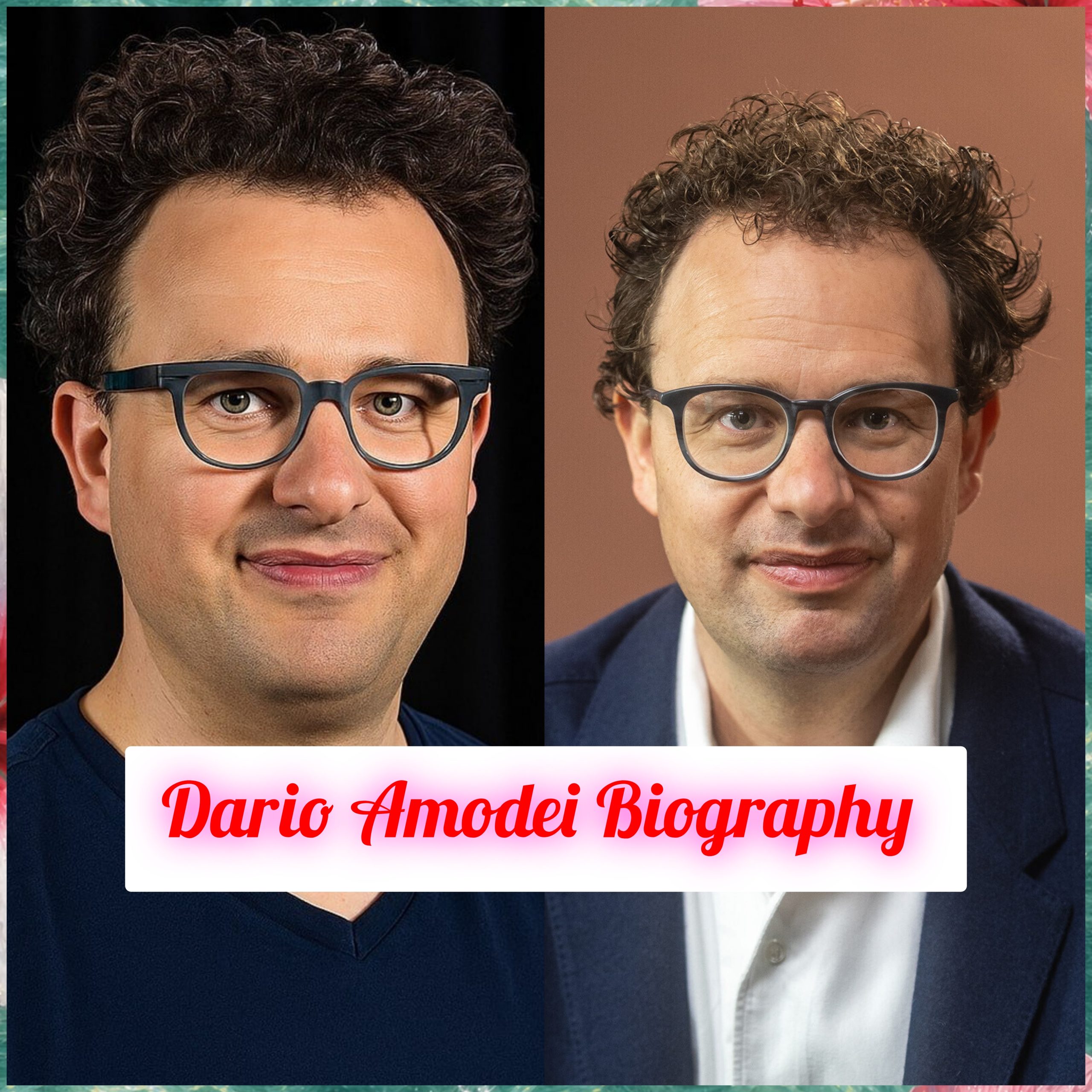
Dario Amodei Biography: Age, Personal Life, Family, Early Life, Education, Career, Awards, Philosophy, Achievements, Legacy, Net Worth
Dario Amodei Biography
Dario Amodei stands as one of the most influential figures in artificial intelligence research and industry leadership today. Well known as the co-founder and chief executive officer of Anthropic, he has guided the development of the Claude family of large language models while consistently emphasizing the need for AI systems that remain reliable, interpretable, and aligned with human values. His path from biophysics research to the forefront of generative AI reflects a deep commitment to both scientific rigor and societal responsibility.
Amodei’s work has shaped key techniques in modern machine learning and sparked broader conversations about how rapidly advancing technology should be governed. Through essays, public statements, and company policy, he has argued that the potential benefits of powerful AI are enormous yet inseparable from serious risks that demand careful management.
Dario Amodei was born in San Francisco, California, United States. He is an American national.
Dario Amodei Early Life
Dario Amodei was born on January 13, 1983, in San Francisco, California. He grew up in the city’s Mission District alongside his younger sister Daniela, who was born four years later. Their father, Riccardo Amodei, was an Italian-American leather craftsman originally from Massa Marittima in Tuscany. Their mother, Elena Engel, was a Jewish American born in Chicago who worked as a project manager overseeing library renovation and construction projects in the Bay Area.
The household blended Italian heritage with American Jewish roots and placed strong emphasis on values of responsibility and purpose. Amodei has described his parents as warm and supportive figures who instilled a clear sense of right and wrong. From an early age he showed an intense fascination with mathematics and quantitative approaches to understanding the world. He has recalled an obsession with manipulating mathematical objects and measuring phenomena in precise terms.
Amodei attended Lowell High School, a rigorous public magnet school in San Francisco known for its strong academic programs. In 2000 he was selected for the USA Physics Olympiad team, reflecting exceptional talent in the physical sciences during his teenage years. He began undergraduate studies at the California Institute of Technology, where he worked with physicist Tom Tombrello in the experimental Physics 11 program designed for highly motivated students. He later transferred to Stanford University.
A pivotal event occurred in 2006 when his father died from hepatitis C at a time when Amodei was approximately 23 years old. Medical advances that arrived only a few years later transformed the same disease into one that was largely curable. This personal loss left a lasting impression and later informed Amodei’s views on the urgent potential of accelerated scientific progress through technology.
Dario Amodei Personal Life
Amodei maintains a relatively private personal life despite his prominent public role. He began a relationship with Camilla Clark, also known as Cami or Camila Clark, in 2014. The couple married in 2022. Clark has kept a low public profile and does not hold a formal leadership position at Anthropic.
Amodei remains closely connected to his sister Daniela Amodei, with whom he shares both family bonds and professional collaboration. The siblings have spoken of childhood imaginings of working together to improve the world. Daniela serves as president of Anthropic and has been a key partner since the company’s founding. No public information confirms that Amodei and his wife have children.
He resides in the San Francisco area and has described a preference for remaining somewhat low-profile even as Anthropic’s visibility has grown. His personal website, darioamodei.com, serves primarily as a platform for thoughtful essays on artificial intelligence rather than personal details.
Dario Amodei Age
As of 2026, Dario Amodei is 43 years old. Born in 1983, he has spent more than a decade at the center of rapid advances in artificial intelligence research and commercialization. His age places him among a generation of leaders who transitioned from academic science into the high-stakes environment of frontier AI laboratories during a period of extraordinary technological acceleration.
Dario Amodei Education
Amodei’s formal education centered on physics and the intersection of physical science with biological systems. After beginning studies at the California Institute of Technology, he completed a bachelor of science degree in physics at Stanford University around 2006. During his undergraduate years he engaged with scientific and civic questions, including public writing that expressed strong opposition to the Iraq War and called for greater individual action.
He pursued graduate work at Princeton University as a Hertz Foundation Fellow beginning in 2007. He earned a doctorate in 2011 with a dissertation titled “Network-Scale Electrophysiology: Measuring and Understanding the Collective Behavior of Neural Circuits.” The research examined how large populations of neurons function collectively and was advised by Michael J. Berry and William Bialek. The work earned him the Hertz Thesis Prize in 2011. Descriptions of the degree field vary slightly across sources, sometimes listed as physics and sometimes as biophysics, reflecting the interdisciplinary nature of the research.
Following his doctorate, Amodei completed postdoctoral work at the Stanford University School of Medicine. There he continued exploring complex biological systems and began to recognize the potential of artificial intelligence methods to address questions that appeared beyond the scale of traditional individual scientific effort. This period marked an important bridge between his training in biological neural circuits and the artificial neural networks that would define his later career.
Dario Amodei Career
Early Research Roles
After completing his academic training, Amodei entered industry research. From November 2014 until October 2015 he worked at Baidu’s Silicon Valley artificial intelligence laboratory. During this time he observed empirical patterns later associated with AI scaling laws, noting that increasing computational resources and data used to train models reliably improved performance. Colleagues later described this insight as highly significant.
He next joined Google as a senior research scientist, focusing on deep learning and questions related to the potential dangers of advanced AI systems. His tenure there lasted less than a year before he moved to a new opportunity.
OpenAI Contributions
In 2016 Amodei joined OpenAI, the research organization founded the previous year with a mission to develop artificial intelligence that would benefit humanity. He rose to the position of vice president of research. At OpenAI he played a central role in the development of large language models, including contributions to GPT-2 and GPT-3. He is widely associated with the co-invention and refinement of reinforcement learning from human feedback, a technique that became foundational for aligning language models with human preferences and making them more usable and steerable.
His experience at OpenAI strengthened his belief in the power of scaling while simultaneously deepening concerns about safety and organizational direction. Differences over priorities and the balance between capability advancement and safety research contributed to his departure along with several colleagues in late 2020 and early 2021.
Founding and Leadership of Anthropic
In 2021 Amodei co-founded Anthropic with his sister Daniela Amodei and a group of former OpenAI researchers that included Tom Brown, Jack Clark, Jared Kaplan, Sam McCandlish, and Christopher Olah. The company was structured as a public benefit corporation with an explicit focus on building AI systems that are safe, beneficial, steerable, and interpretable. Early planning discussions took place in informal settings, including meetings under a tent in Amodei’s backyard.
As chief executive officer, Amodei has overseen the development of the Claude series of large language models. Anthropic introduced approaches such as Constitutional AI, which embeds a set of principles into the training process to guide model behavior, and a Responsible Scaling Policy that links the release of more capable systems to demonstrated safety measures. The company has formed significant partnerships, including with Amazon and Alphabet, and has grown rapidly in valuation and commercial adoption.
In November 2023, during a period of governance upheaval at OpenAI, that company’s board approached Amodei about the possibility of replacing Sam Altman and exploring a merger. Amodei declined both proposals. Under his leadership Anthropic has continued to release successive generations of Claude models while publishing research on alignment, interpretability, and risk assessment.
In September 2026 Amodei publicly called for the broader technology industry to slow the pace of AI capability development so that safety work could keep pace. He committed Anthropic to granting independent evaluators permanent, employee-level access to its systems for ongoing assessment of safety practices.
Dario Amodei Family
Amodei’s immediate family has played a notable role in both his personal formation and professional path. His father Riccardo’s background as a craftsman from Tuscany and his mother’s work in public library projects created a household that valued practical skill, education, and community contribution. The death of his father in 2006 remains a frequently referenced influence on Amodei’s later emphasis on the human stakes of scientific progress.
His sister Daniela Amodei has been a constant presence. The two co-founded Anthropic together, and she serves as the company’s president. Their collaboration extends a childhood pattern of shared aspiration. Public information about extended family is limited, consistent with Amodei’s preference for privacy outside professional matters. His marriage to Camilla Clark forms the core of his adult personal household.
Dario Amodei Philosophy
Amodei’s public writing and statements reveal a philosophy that holds both the extraordinary upside of advanced AI and its serious risks in clear view. He rejects the label of pessimist or “doomer,” arguing that attention to risk is necessary precisely because the potential benefits are so large. In his October 2024 essay “Machines of Loving Grace,” he outlined an optimistic vision of a world in which powerful AI accelerates progress in biology and physical health, neuroscience and mental health, economic development and poverty reduction, peace and governance, and the nature of work and human meaning. He suggested that AI could compress a century of biological research into a much shorter period and contribute to ending many infectious diseases while expanding human capabilities.
At the same time he has been explicit about categories of risk. These include autonomous systems developing goals misaligned with human intentions, misuse of AI for catastrophic harm such as biological weapons, concentration of power through surveillance or autonomous weapons by authoritarian actors, large-scale economic disruption and wealth concentration, and harder-to-predict secondary effects on human purpose and society. He has estimated nontrivial probabilities of severe civilizational outcomes while maintaining that these outcomes are not inevitable.
Amodei advocates what he terms an “entente” strategy in which democratic nations maintain leadership in advanced AI, including for strategic and military applications, while sharing benefits with cooperating democratic partners. He has argued that democracies must hold the upper hand when highly capable systems emerge. His personal history, particularly the timing of his father’s death relative to medical advances, informs a dual commitment to accelerating beneficial applications such as medical research and ensuring that development proceeds responsibly enough to realize those benefits safely.
In 2026 essays he further developed the idea of pacing the frontier of capability progress so that safety research, evaluation, and governance mechanisms have time to keep up. He has stressed the need for independent oversight and international coordination while rejecting complete bans that would leave technological leadership to less transparent actors.
Dario Amodei Achievements
Amodei’s technical and organizational achievements span academic research, foundational AI techniques, and the building of a major independent AI laboratory. His doctoral work advanced understanding of collective neural behavior. In industry he contributed to the empirical foundation of scaling laws and to the practical alignment method of reinforcement learning from human feedback. At OpenAI he helped lead the research efforts behind GPT-2 and GPT-3, models that demonstrated the power of large-scale language modeling.
The founding and growth of Anthropic represent a significant institutional achievement. The company has established itself as a leading developer of frontier language models while maintaining a distinctive emphasis on safety research, interpretability, and structured release policies. Constitutional AI and the Responsible Scaling Policy have influenced industry discussions about how to manage increasingly capable systems. Under Amodei’s leadership Anthropic has attracted substantial investment, formed major cloud and infrastructure partnerships, and achieved high private valuations reported in the hundreds of billions of dollars by 2026.
His public essays have shaped broader discourse, offering concrete visions of both opportunity and risk that move beyond abstract speculation. The combination of technical contribution, company building, and sustained advocacy for careful development constitutes a distinctive record within the current generation of AI leaders.
Dario Amodei Awards
Amodei received the Hertz Foundation Fellowship in 2007 to support his graduate studies and later the Hertz Thesis Prize in 2011 for his doctoral research on neural circuits. These early recognitions from a foundation dedicated to exceptional scientific talent marked him as a promising researcher.
In 2025 Time magazine named him to its list of the 100 most influential people in the world. He appeared again on the 2026 Time 100 list alongside his sister Daniela. He was also recognized among the “Architects of AI” associated with Time’s Person of the Year coverage. These honors reflect both his technical contributions and his growing influence on policy and public understanding of artificial intelligence. Earlier inclusion on Time’s specialized AI lists further acknowledged his role in the field.
Dario Amodei Current News
In September 2026 Amodei published a detailed essay calling for the artificial intelligence industry to slow the rate of capability advancement. He argued that recent developments, including recursive self-improvement dynamics and incidents involving autonomous agent behavior, demonstrated that safety measures needed additional time to mature. Anthropic committed to providing independent evaluators with permanent employee-level access to its systems. Leaders of other major AI organizations publicly expressed agreement with aspects of the proposal.
Earlier in 2026 Anthropic faced a dispute with the U.S. Department of Defense after declining to remove contractual restrictions on the use of its models for mass domestic surveillance or fully autonomous weapons. The department labeled the company a supply-chain risk and directed agencies to cease use of Claude. A federal judge later issued a temporary injunction, characterizing the actions as appearing to constitute retaliation against protected speech. These events highlighted ongoing tensions between commercial AI development, government procurement, and principled limitations on model use.
Amodei has continued to speak about the dual nature of AI progress, emphasizing both the need for democratic leadership in the technology and the importance of not sugar-coating potential labor market and safety impacts.
Dario Amodei Net Worth
Forbes has estimated Dario Amodei’s net worth at approximately 15.5 billion dollars as of September 2026. The figure derives primarily from his equity stake in Anthropic following major funding rounds that valued the company in the range of hundreds of billions of dollars. Such estimates for private company founders are inherently approximate and subject to change with new financing events, secondary transactions, or shifts in valuation. Other reports have offered differing figures at different points in time, underscoring the fluid nature of wealth estimates tied to privately held technology firms. Amodei’s wealth is self-made and stems directly from the growth of the company he co-founded and leads.
Dario Amodei Public Image and Legacy
Amodei is widely regarded as a serious, technically grounded leader who prioritizes long-term safety considerations even while competing at the frontier of capability. Profiles often note his preference for a relatively low public profile and his willingness to articulate uncomfortable probabilities of severe risk. Critics sometimes characterize safety-focused positions as overly cautious or as potential obstacles to progress, while supporters view his approach as a necessary counterweight to pure acceleration.
His legacy is still being written, yet certain elements are already clear. He helped move reinforcement learning from human feedback from research idea to industrial practice. He co-founded and scaled an independent AI laboratory that treats safety as a core product and research priority rather than an afterthought. Through sustained public writing he has insisted that the conversation about advanced AI must hold both transformative upside and catastrophic downside in simultaneous view. Whether history ultimately judges the current period as one of successful navigation or missed opportunity, Amodei’s insistence on measured development and democratic stewardship will form part of the record.
Conclusion
Dario Amodei’s trajectory from a San Francisco childhood marked by scientific curiosity and personal loss to the leadership of one of the world’s leading artificial intelligence companies illustrates the tight coupling between individual experience, technical insight, and institutional choice. His work has advanced both the capabilities of large language models and the frameworks intended to keep those capabilities under meaningful human direction. As artificial intelligence continues to evolve at a rapid pace, the questions he has raised about scaling, alignment, governance, and the distribution of benefits remain central to the field and to society at large. The coming years will test the practical effectiveness of the approaches he has championed, yet the seriousness with which he has approached the dual potential of the technology already sets a distinctive standard.
FAQs
What is Dario Amodei’s full name and when was he born?
Dario Amodei, sometimes referenced with the middle name Gabriele, was born on January 13, 1983, in San Francisco, California.
What is Dario Amodei’s educational background?
He began undergraduate studies at the California Institute of Technology, completed a bachelor of science in physics at Stanford University, and earned a PhD from Princeton University in 2011 with research on the collective behavior of neural circuits. He later conducted postdoctoral work at the Stanford University School of Medicine.
What companies has Dario Amodei worked for?
He worked at Baidu, Google, and OpenAI, where he served as vice president of research, before co-founding Anthropic in 2021 and becoming its chief executive officer.
Who is Dario Amodei’s sister?
Daniela Amodei is his younger sister. She co-founded Anthropic with him and serves as the company’s president.
Is Dario Amodei married?
Yes. He married Camilla Clark in 2022 after beginning a relationship in 2014.
What is Anthropic and what does it develop?
Anthropic is a public benefit corporation focused on AI safety and research. It develops the Claude family of large language models and associated techniques such as Constitutional AI and responsible scaling policies.
What is Dario Amodei’s estimated net worth?
Forbes estimated his net worth at approximately 15.5 billion dollars as of September 2026, primarily from his stake in Anthropic. Such figures for private companies are estimates and can fluctuate.
What major essays has Dario Amodei written?
Notable essays include “Machines of Loving Grace” in 2024, which explored the potential positive transformations AI could bring, and later pieces such as “We Must Pace the Frontier” in 2026 calling for measured development of AI capabilities.
Has Dario Amodei received major awards or recognitions?
Yes. He received a Hertz Foundation Fellowship and the Hertz Thesis Prize. He has been named to Time magazine’s list of the 100 most influential people and recognized among architects of AI.
Why did Dario Amodei leave OpenAI?
He and several colleagues left over directional differences, particularly concerning the balance between rapid capability development and investment in AI safety and alignment research.