Léopold Sédar Senghor Biography: Early Life, Age, Personal Life, Family, Education, Career, Awards, Death, Net Worth
Léopold Sédar Senghor Biography
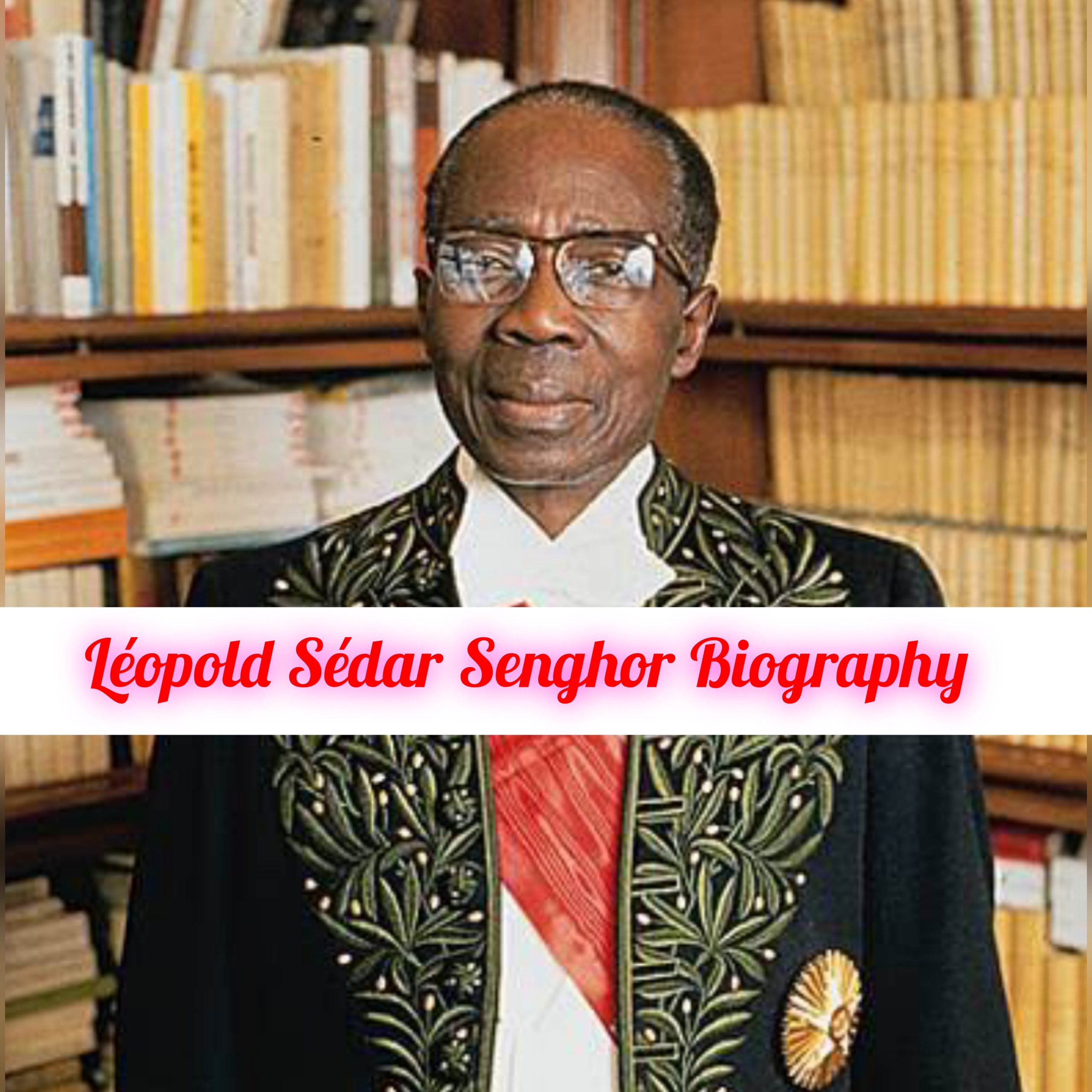
Léopold Sédar Senghor remains among the most influential figures of twentieth century Africa, a man whose life bridged poetry and politics, African heritage and European intellectual traditions. As a poet he gave voice to the cultural richness of Black experience. As a statesman he guided Senegal through its first two decades of independence with a steady hand that favored dialogue over confrontation.
His work as a thinker helped shape the idea that African values could contribute fully to a shared human civilization. The path he followed from a coastal village in Senegal to the highest offices of his nation and to a seat in the French Academy remains a remarkable story of intellectual ambition and public service.
Léopold Sédar Senghor was born in Joal, Senegal, then part of French West Africa, and held Senegalese nationality while also holding French citizenship for much of his adult life.
Léopold Sédar Senghor Early Life
Léopold Sédar Senghor was born on 9 October 1906 in Joal, a small coastal town roughly one hundred and ten kilometres south of Dakar. Joal lay in the Serer heartland of the Sine region, an area of fishing villages, peanut fields and traditional kingdoms that had long interacted with European traders. His father, Basile Diogoye Senghor, was a prosperous Serer planter, cattle owner and peanut merchant who belonged to the local aristocracy. His mother, Gnilane Ndiémé Bakhoum, came from a Christian family of mixed Serer and Fulani background and was the third of Basile’s wives. She gave birth to six children, of whom Léopold was one of the sons.
The family lived in relative comfort. Basile owned extensive lands and livestock, some of which had been granted by relatives connected to the traditional rulers of Sine. Young Léopold spent his earliest years partly with his mother’s kin in Djilor before returning to his father’s household. The household was large, with numerous half siblings, and the atmosphere combined Catholic practice with the deeper rhythms of Serer custom and animist belief that still shaped daily life in the region.
At about the age of seven he began attending the Catholic mission school in Joal under Father Dubois. There he learned the catechism and the first elements of French. He later moved to the Spiritan Fathers’ school at Ngazobil, where he spent six years. The curriculum emphasised Latin, French literature and classical subjects. Senghor proved an outstanding pupil. His teachers recognised both his intelligence and his seriousness. For a time he felt drawn to the priesthood and entered the Libermann Seminary in Dakar. After several years the seminary directors concluded that he lacked a true vocation for the religious life. He transferred to the secular secondary school that later became the Lycée Van Vollenhoven, today known as Lycée Lamine Guèye.
In that environment he excelled in French, Latin, Greek and mathematics. He completed the baccalaureate with high marks. The colonial administration awarded him a partial scholarship, and in 1928, at the age of twenty two, he left Senegal for the first time to continue his studies in France. The departure marked the end of a childhood deeply rooted in Serer soil and the beginning of a long engagement with French culture that would never erase his African identity.
Léopold Sédar Senghor Personal Life
Senghor’s personal life reflected the dual worlds he inhabited. He remained a practising Catholic throughout his life, yet he never abandoned the cultural and spiritual references of his Serer upbringing. Friends and colleagues described him as reserved, disciplined and intensely focused on both literary creation and public duty. He maintained close intellectual friendships formed in Paris, notably with Aimé Césaire and Léon Gontran Damas, the other principal architects of the Négritude movement.
His private correspondence and later reflections reveal a man who valued order, contemplation and the company of books. After leaving the presidency he spent increasing time in Normandy, the region of his second wife’s family, where he found the quiet necessary for writing and reflection. Even in retirement he remained attentive to cultural and political developments in both Senegal and France. Those who knew him in his later years noted his courtesy, his precise speech and his continuing curiosity about language, history and the arts.
Léopold Sédar Senghor Age
Léopold Sédar Senghor lived to the age of ninety five. Born on 9 October 1906, he died on 20 December 2001 at his home in Verson, near Caen in Normandy. His long life allowed him to witness the full arc of colonial rule, the struggle for independence, the challenges of nation building and the gradual recognition of African intellectual contributions on the world stage. He remained intellectually active into advanced age, publishing essays and poetry and participating in the work of the Académie française until shortly before his death.
Léopold Sédar Senghor Education
Senghor’s formal education began in the Catholic mission schools of Joal and Ngazobil and continued at the Libermann Seminary and the secular lycée in Dakar. After obtaining the baccalaureate he travelled to Paris in 1928. He first enrolled at the Sorbonne but soon transferred, with the assistance of the Senegalese deputy Blaise Diagne, to the prestigious Lycée Louis le Grand. There he prepared for the competitive entrance examination to the École Normale Supérieure. Among his classmates was Georges Pompidou, the future president of France.
He studied classical languages, French literature and philosophy. In order to sit the agrégation, the highest teaching qualification in the French system, he obtained French citizenship in 1933. In 1935 he became the first African to pass the agrégation in grammar. This achievement opened the doors of the French educational establishment. He taught classics and literature at the Lycée Descartes in Tours and later at the Lycée Marcelin Berthelot. After the Second World War he was appointed professor of African languages and civilisation at the École Nationale de la France d’Outre Mer.
His scholarly formation combined rigorous training in European humanities with a growing interest in African linguistics, ethnography and oral traditions. He studied African languages at the École des Hautes Études and remained a lifelong student of both classical and modern literature. The breadth of his education enabled him to move with equal ease between the lecture hall, the political assembly and the poet’s desk.
Léopold Sédar Senghor Career
Academic and Literary Work
After completing the agrégation, Senghor began teaching in French secondary schools. His classroom work was interrupted by the outbreak of the Second World War. Drafted into the French army in 1939, he served as a private in a colonial infantry regiment. He was captured by German forces in June 1940 and spent nearly two years as a prisoner of war. During captivity he wrote some of his most powerful poems, later collected in Hosties noires. Upon his release he joined the French Resistance.
In the postwar years he continued teaching while deepening his literary output. His first major collection, Chants d’ombre, appeared in 1945. It was followed by Hosties noires in 1948, Éthiopiques in 1956, Nocturnes in 1961, Lettres d’hivernage in 1973 and Élégies majeures in 1979. He also edited the influential Anthologie de la nouvelle poésie nègre et malgache de langue française in 1948, for which Jean Paul Sartre wrote the celebrated preface “Orphée noir.” These works established him as a leading voice of African poetry in French and as a central theorist of Négritude.
Political Career in France and Senegal
Senghor entered formal politics after the war. In 1945 and 1946 he was elected to the French Constituent Assemblies as a representative of Senegal. He then served as a deputy in the French National Assembly from 1946 to 1959. During this period he held junior ministerial posts, including Secretary of State in the office of the President of the Council in 1955 and 1956. He also represented France at the United Nations.
In 1948 he founded the Bloc Démocratique Sénégalais, which later evolved into the Union Progressiste Sénégalaise and eventually the Socialist Party of Senegal. He advocated a federal structure that would keep African territories linked to France while granting them greater autonomy. When full independence became inevitable, he worked for a peaceful transition. In 1959 Senegal joined French Sudan in the short lived Mali Federation. After the federation dissolved in August 1960, Senegal became an independent republic. Senghor was elected its first president on 5 September 1960.
Presidency of Senegal
As president from 1960 to 1980, Senghor pursued a policy of African socialism that sought to modernise the economy while preserving social cohesion and cultural identity. He maintained close ties with France, secured development assistance and invested in education, infrastructure and the arts. In 1962 a political crisis arose when Prime Minister Mamadou Dia attempted to challenge presidential authority. Senghor prevailed, and Dia was imprisoned. Thereafter Senghor consolidated power within a dominant party system, though he gradually introduced limited multiparty competition in the 1970s.
He was re elected in 1963, 1968, 1973 and 1978. Throughout his tenure he remained committed to cultural promotion. In 1966 Dakar hosted the First World Festival of Negro Arts, a landmark event that brought artists and intellectuals from across the African diaspora. Senghor also supported the creation of universities, museums and research institutions. On 31 December 1980 he resigned voluntarily, the first African president of the independence generation to leave office by choice. He transferred power to his long time collaborator Abdou Diouf.
Later Public Roles
After leaving the presidency Senghor continued to write and to serve on cultural bodies. In 1983 he was elected to the Académie française, becoming the first African member of that institution. He took his seat in 1984 in a ceremony attended by President François Mitterrand. He remained active in the promotion of the Francophonie and in intellectual exchanges between Africa and Europe until the final years of his life.
Léopold Sédar Senghor Family
Senghor married twice. On 12 September 1946 he wed Ginette Éboué, daughter of the distinguished colonial administrator Félix Éboué. The couple had two sons, Francis Arphang, born in 1947, and Guy Wali, born in 1948. The marriage ended in divorce in 1955 or 1956. Guy Wali died in 1983 after a fall from a Paris apartment. Francis Arphang lived into the 2020s.
In 1957 Senghor married Colette Hubert, a French woman from Normandy. Their son, Philippe Maguilen, was born in 1958 and died in a car accident in Dakar in 1981. Colette became Senegal’s first First Lady and remained a constant companion during Senghor’s later years in Verson. She survived him and died in 2019. Senghor’s family life was marked by both public dignity and private sorrow, particularly the early deaths of two of his three sons.
Léopold Sédar Senghor Philosophy
At the heart of Senghor’s thought lay the concept of Négritude. Developed in the 1930s in Paris together with Aimé Césaire and Léon Damas, Négritude affirmed the distinctive cultural values of the Black world. Senghor defined it as the sum of the cultural, economic, social and political values of the Black peoples of Africa and the diaspora. Far from a rejection of Europe, he presented Négritude as a necessary contribution to a future universal civilisation in which all cultures would meet as equals.
He argued that African civilisations were characterised by a sense of community, rhythm, emotion and participation in the cosmic order. These qualities, he believed, could complement the analytical and technological strengths of European culture. His essays, collected in the multi volume series Liberté, explored the relationship between African identity and modernisation. He rejected both uncritical imitation of the West and isolationist withdrawal. Instead he proposed a creative synthesis.
Politically, this vision took the form of African socialism. Senghor distinguished his approach from both Soviet style Marxism and Western social democracy. African socialism, in his view, grew from traditional communal structures and spiritual values. It sought economic development without class warfare and without the erasure of cultural particularity. He remained critical of rigid ideology and favoured pragmatic adaptation to African realities. His philosophy consistently returned to the ideal of dialogue, reciprocity and the enrichment of humanity through cultural diversity.
Léopold Sédar Senghor Achievements
Senghor’s achievements span literature, politics and cultural advocacy. As a poet he produced a body of work that remains central to Francophone African literature. Collections such as Chants d’ombre, Hosties noires and Éthiopiques introduced readers to a poetic language that fused African imagery, classical form and modern free verse. His anthology of Black poetry helped define a generation of writers.
As a political leader he guided Senegal to independence without major violence and maintained relative stability during a turbulent period in African history. He was the first African head of state of the independence era to leave office voluntarily. His cultural initiatives, including the 1966 World Festival of Negro Arts, gave global visibility to African creativity. His election to the Académie française marked a historic recognition of African intellectual contribution to the French language and its institutions. Through his writings and public actions he helped establish the idea that African cultures possess intrinsic value and that their full participation is essential to any genuine universal humanism.
Léopold Sédar Senghor Awards
Senghor received numerous distinctions during his lifetime. He was made Grand Croix of the Légion d’honneur and Grand Croix of the Ordre national du Mérite. He was Commander of the Ordre des Arts et des Lettres and of the Palmes académiques. He held the Grand Cross of Senegal’s National Order of the Lion.
Literary and intellectual honours included the gold medal of the French Language Prize of the Académie française in 1963, the International Grand Prize for Poetry in 1963, the Dag Hammarskjöld International Prize for poetic merit, the German Book Trade’s Peace Prize in 1968, the Guillaume Apollinaire Prize in 1974, the Cino del Duca Prize in 1978 and the International Nonino Prize in 1985. He was named Prince of Poets in 1978. He received honorary doctorates from thirty seven universities, among them the Sorbonne, Oxford, Harvard, Louvain and many African and European institutions. In 1983 he was elected to the Académie française, the first African to hold a seat in that body. These awards recognised both his literary accomplishment and his lifelong commitment to cultural dialogue.
Léopold Sédar Senghor Literary Works
Senghor’s poetry forms the core of his literary legacy. Chants d’ombre (1945) evokes childhood memories of Joal and the Serer landscape. Hosties noires (1948) contains poems written during captivity and reflects on war, race and sacrifice. Éthiopiques (1956) explores African history and identity, including the long dramatic poem “Chaka.” Nocturnes (1961) gathers lyrical and meditative pieces, some of them love poems addressed to an idealised African feminine presence. Later collections such as Lettres d’hivernage and Élégies majeures deepen themes of time, loss and spiritual continuity.
His prose writings, gathered in the five volumes of Liberté, address Négritude, African socialism, education, language policy and the idea of a civilisation of the universal. He also co authored a children’s book, La Belle Histoire de Leuk le Lièvre, and translated poetry from English. The national anthem of Senegal, “Le Lion rouge,” is among his compositions. Together these works demonstrate a consistent effort to make African experience audible within the French language while expanding the expressive range of that language itself.
Léopold Sédar Senghor Legacy
Senghor’s influence continues in Senegal, across Africa and in global discussions of culture and identity. The international airport in Dakar bears his name. Universities, schools and cultural centres honour his memory. His poetry remains widely studied and translated. The concept of Négritude, though debated and sometimes criticised by later generations, remains a foundational reference in African and diaspora intellectual history.
In recent years Senegal has acted to preserve elements of his personal heritage, acquiring objects and books that had been offered for sale in France. These efforts reflect a national desire to keep his material legacy within the country. Scholars continue to examine his dual identity as African and French, poet and politician, traditionalist and modernist. His life offers a model of cultural confidence combined with openness to exchange. Whether judged by literary standards, political outcomes or philosophical ambition, Senghor occupies a permanent place among the architects of modern African thought.
Conclusion
Léopold Sédar Senghor lived a life of extraordinary range. From the peanut fields and fishing shores of Joal he rose to the presidency of an independent nation and to a seat among the immortals of the French Academy. He gave the world a poetry rooted in African soil yet fully conversant with European form. He offered a political vision that sought development without cultural erasure. He articulated a philosophy of Négritude that insisted on the equal dignity of African civilisation within a shared human future.
His career was not free of controversy. Critics questioned his close ties to France, his handling of political opposition and certain aspects of his cultural theory. Yet the larger record shows a man who consistently chose dialogue over rupture and who believed that Africa’s contribution to humanity was both necessary and unfinished. In an age still grappling with questions of identity, memory and global exchange, Senghor’s work retains its power to instruct and to inspire. He remains a bridge between continents and a witness to the possibility of creative synthesis.
FAQs
Who was Léopold Sédar Senghor?
Léopold Sédar Senghor was a Senegalese poet, cultural theorist and statesman who served as the first president of independent Senegal from 1960 to 1980. He was also a principal founder of the Négritude movement and the first African elected to the Académie française.
When and where was Léopold Sédar Senghor born?
He was born on 9 October 1906 in Joal, a coastal town in the Serer region of Senegal, then part of French West Africa.
What is Négritude according to Senghor?
Senghor defined Négritude as the totality of the cultural values of the Black world as expressed in the life, institutions and works of Black peoples. He saw it as a positive affirmation of African identity and a necessary contribution to a universal human civilisation.
How long did Senghor serve as president of Senegal?
He served from September 1960 until 31 December 1980, a period of just over twenty years. He resigned voluntarily and transferred power to Abdou Diouf.
What are Senghor’s most important literary works?
His major poetry collections include Chants d’ombre (1945), Hosties noires (1948), Éthiopiques (1956), Nocturnes (1961) and Élégies majeures (1979). His essays appear in the multi volume series Liberté.
Did Senghor receive French citizenship?
Yes. He was naturalised as a French citizen in 1933 so that he could sit the agrégation examination. He retained French citizenship alongside his Senegalese nationality.
When did Léopold Sédar Senghor die?
He died on 20 December 2001 at the age of ninety five in Verson, Normandy, France. He was buried in Dakar.
What was African socialism in Senghor’s thought?
African socialism, as Senghor conceived it, was a form of socialism rooted in traditional African communal values and spiritual life. It rejected both the dictatorship of the proletariat and pure market capitalism, seeking instead a democratic path to modernisation that preserved cultural identity.