Modibo Keïta Biography: Early Life, Age, Personal Life, Family, Education, Career, Awards, Philosophy, Achievements, Legacy, Net Worth, Death
Modibo Keïta Biography
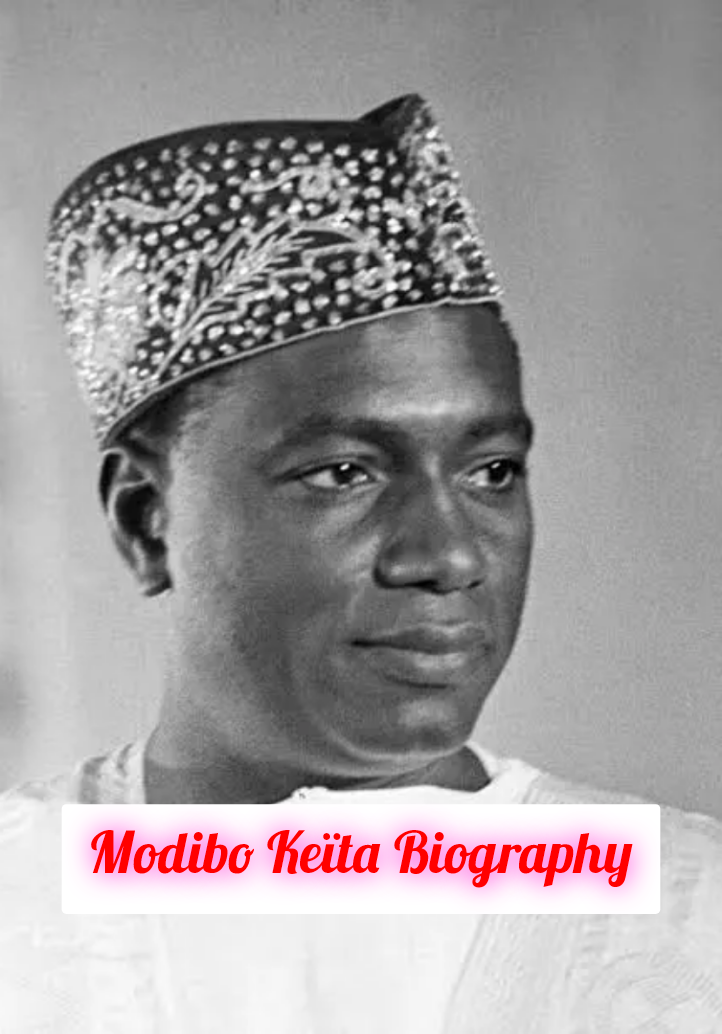
Modibo Keïta stands as one of the central figures in the history of modern West Africa. As a teacher turned statesman, he guided French Sudan through the final years of colonial rule and became the first president of independent Mali. His leadership combined a deep commitment to African unity with a determined effort to build a socialist society free from lingering colonial influence.
His life reflected the broader struggles of a generation of African leaders who sought political freedom and economic self-determination in the mid-twentieth century. Keïta’s career moved from classroom instruction to territorial politics, from the French National Assembly to the presidency of a newly independent nation, and finally to years of detention after a military coup.
Modibo Keïta was born in Bamako, French Sudan (now Mali), and held Malian nationality after independence in 1960.
Modibo Keïta Early Life
Modibo Keïta was born on 4 June 1915 in Bamako-Coura, a neighborhood of Bamako, then the capital of the French colony known as Upper Senegal and Niger and later as French Sudan. He belonged to a Muslim Malinké family that claimed direct descent from the Keita dynasty, the ruling house of the medieval Mali Empire founded by Sundiata Keita in the thirteenth century. His parents were Daba Keïta and Fatoumata Camara. The family lived under French colonial administration, and young Modibo grew up in an environment shaped by both traditional Islamic practice and the realities of colonial rule.
He received his primary education in Bamako between 1925 and 1931 at the urban primary school. In 1931 he entered the École Primaire Supérieure Terrasson de Fougères (later renamed Lycée Askia Mohamed). Demonstrating strong academic ability, he ranked first in the Sudanese competitive entrance examination for the prestigious École Normale William-Ponty in Dakar, Senegal. He studied there from 1934 to 1936 and graduated at the top of his class with the diploma of instituteur (qualified primary teacher).
After completing his training, Keïta began teaching in 1936. He served in Bamako, Sikasso, and later Tombouctou. Colonial authorities described him as an elite teacher of high intelligence yet also noted his critical attitude toward French administration. These early professional years coincided with the growth of cultural and mutual-aid associations among educated Africans, activities in which Keïta took an active part.
Modibo Keïta Personal Life
Keïta lived according to the customs of his Muslim Malinké background, which permitted polygamy. He married three wives over the course of his life. His first marriage, in September 1939, was to Mariam Travélé, herself a teacher and the daughter of a railway worker. She later became the first First Lady of independent Mali and remained a public figure until her death in 2014. In 1952 he married Fatoumata “Didi” Haïdara, who died in 1976. His third wife was Fatoumata Diallo (also known as Keïta Fatoumata Diallo or Fanto Diallo), born in 1943 and married in 1959; she died in 2025.
Keïta maintained a private life centered on family and Islamic practice while carrying the heavy public responsibilities of political leadership. After his overthrow in 1968 he spent the remaining years of his life in detention, first in the remote northern town of Kidal and later in Bamako. He died in detention on 16 May 1977 at the age of 61. Official reports cited pulmonary edema, though the circumstances of his death have long been regarded as suspicious by many observers.
Modibo Keïta Age
Modibo Keïta was born on 4 June 1915 and died on 16 May 1977. He was 61 years old at the time of his death.
Modibo Keïta Education
Keïta’s formal education followed the limited path available to promising African students under French colonial rule. After primary schooling in Bamako he advanced to the École Primaire Supérieure Terrasson de Fougères. His outstanding results allowed him to enter the École Normale William-Ponty in Dakar, the leading teacher-training institution for French West Africa. There he studied alongside future leaders from across the region and graduated first in his class in 1936 with the qualification of instituteur.
This education equipped him with both pedagogical skills and a critical understanding of colonial society. William-Ponty alumni formed an important network of African intellectuals and future politicians. Keïta’s success at the school marked him early as a capable and ambitious figure within the colonial education system.
Modibo Keïta Career
Teaching and Early Political Activity
Keïta began his professional life as a teacher in 1936. He taught in Bamako, Sikasso, and Tombouctou. During these years he helped organize the Union of French West African Teachers with Ouezzin Coulibaly, advocating better conditions for African educators. He also participated in cultural groups such as the art and theater circle and joined Communist Study Groups in Bamako. In 1943 he contributed to the anti-colonial magazine L’Œil de Kénédougou, an activity that led to a brief period of imprisonment by French authorities in 1946.
Formation of Political Parties and Electoral Success
In 1945 Keïta co-founded the Sudanese Union with Mamadou Konaté and became its secretary-general. The following year the party affiliated with the African Democratic Rally (Rassemblement Démocratique Africain, RDA) at the Bamako congress, creating the Sudanese Union–African Democratic Rally (US-RDA). French authorities viewed the movement with suspicion because of its early links to the French Communist Party and its demands for equality. Keïta was briefly detained but continued his political work.
In 1948 he won election to the Territorial Assembly of French Sudan. He was re-elected in subsequent years and rose to vice-president of the assembly. In 1953 he became a councillor of the French Union and chaired its equipment and planning commission. In 1956 he was elected mayor of Bamako and, in the same year, deputy for French Sudan to the French National Assembly. He became the first African to serve as a vice-president of that assembly. Between June and November 1957 he held ministerial posts in French governments as Secretary of State for Overseas France and later as Secretary of State to the Presidency of the Council.
Leadership of the Sudanese Republic and the Mali Federation
In the 1957 territorial elections the US-RDA won an overwhelming victory. In the 1958 referendum on the French Community, Keïta campaigned successfully for French Sudan to become an autonomous republic within the Community. The Sudanese Republic was proclaimed in November 1958. Keïta then worked to create a larger West African federation. Upper Volta and Dahomey withdrew, leaving Senegal and the Sudanese Republic to form the Mali Federation in 1959. Keïta served as president of the constituent assembly and later as head of the federal government.
The federation declared independence on 20 June 1960 but collapsed in August 1960 because of deep political and ideological differences between Keïta’s socialist orientation and the more moderate approach of Léopold Sédar Senghor of Senegal. On 22 September 1960 the Sudanese Republic proclaimed itself the independent Republic of Mali, taking the historic name of the medieval empire. Keïta became its first president the following day.
Presidency of Mali
As president from 1960 to 1968, Keïta established the US-RDA as the sole legal party and pursued a policy of African socialism. The government nationalized key sectors of the economy, including trade, banking, and certain industries, and created state enterprises such as SOMIEX for import-export control. In 1962 Mali introduced its own currency, the Malian franc, and left the CFA franc zone, a move that strained relations with France. French civil servants were replaced by Malians, and the remaining French military presence was ended.
In foreign policy Keïta followed a non-aligned yet clearly progressive line. He maintained relations with both Western and Eastern countries while strengthening ties with the Soviet Union, China, and other socialist states. He played a prominent role in the formation of the Organization of African Unity in 1963 and helped mediate the Sand War between Morocco and Algeria through the Bamako Accords of the same year. Together with Sékou Touré of Guinea and Kwame Nkrumah of Ghana he formed the Union of African States and participated in the Casablanca Group of radical African states.
Economic difficulties mounted during the mid-1960s. A poor harvest in 1968 intensified public discontent. In August 1967 Keïta launched a Cultural Revolution inspired by Maoist models, creating the National Committee for the Defense of the Revolution and intensifying political control. These measures further alienated sections of the population and the army. On 19 November 1968 a group of junior officers led by Lieutenant Moussa Traoré overthrew the government in a bloodless coup. Keïta was arrested and imprisoned.
Modibo Keïta Family
Keïta’s family background linked him to the historic Keita dynasty of the Mali Empire. His parents, Daba Keïta and Fatoumata Camara, raised him in a Muslim household in Bamako-Coura. Through his three marriages he established a large extended family. Mariam Travélé, his first wife, served as First Lady during the early years of independence. Fatoumata “Didi” Haïdara and Fatoumata Diallo completed the household. Details about his children remain less extensively documented in public sources, consistent with the private nature of family life among many African leaders of the era.
Modibo Keïta Philosophy
Keïta’s political thought combined African socialism, pan-Africanism, and a strong insistence on national sovereignty. He rejected both continued colonial economic dependence and uncritical alignment with either the Western or Eastern blocs. He believed that African societies could develop through collective ownership, state planning, and the mobilization of popular energy while drawing on indigenous values and the historical example of the Mali Empire.
His pan-Africanism was practical as well as idealistic. He sought federations and regional unions that would overcome the artificial borders drawn by colonial powers. The short-lived Mali Federation and the Union of African States illustrated this ambition. At the same time he insisted that Mali must control its own currency, trade, and foreign policy. The introduction of the Malian franc and the expulsion of French troops were concrete expressions of this sovereignty.
Later in his presidency the Cultural Revolution of 1967 revealed a more authoritarian turn, with purges and heightened political mobilization. Critics saw this as a departure from earlier pragmatic socialism toward rigid ideological control. Supporters viewed it as an attempt to reinvigorate a faltering revolution. In either interpretation, the episode highlighted the tension between Keïta’s ideals of popular empowerment and the realities of one-party rule.
Modibo Keïta Achievements
Keïta’s most enduring achievement was the peaceful achievement of full independence for Mali on 22 September 1960 and the establishment of the institutions of the new republic. He oversaw the creation of a national currency, the nationalization of key economic sectors, and the replacement of colonial administrators by Malian cadres.
On the continental stage he contributed to the founding of the Organization of African Unity and helped negotiate an end to the Sand War between Morocco and Algeria. His consistent advocacy of non-alignment and African unity earned him respect among progressive leaders of the period. Domestically he expanded education and health services within the limits of available resources and sought to reduce the economic influence of former colonial trading companies.
Modibo Keïta Awards
In 1963 Modibo Keïta received the Lenin Peace Prize in recognition of his efforts to build a socialist economy in Mali and his contributions to peace and African solidarity. In June 1961, during a state visit to the United Kingdom, Queen Elizabeth II invested him as an honorary Knight Grand Cross of the Order of Saint Michael and Saint George.
Modibo Keïta Legacy
After his death in detention in 1977, official memory of Keïta remained muted under the Traoré regime. Following the democratic transition of the 1990s, Mali gradually rehabilitated his image. A Memorial Modibo Keïta was inaugurated in Bamako in 1999. Schools, avenues, and the international airport of Bamako-Sénou now carry his name. Contemporary Malian leaders continue to invoke him as the father of national independence on the annual independence anniversary.
His legacy remains complex. Admirers emphasize his integrity, his refusal of personal enrichment, and his early commitment to genuine sovereignty and African unity. Critics point to the economic hardships of the 1960s, the authoritarian character of the single-party state, and the repressive measures of the Cultural Revolution. Both perspectives acknowledge that Keïta faced the severe constraints of a landlocked, resource-poor country emerging from colonial rule in the context of the Cold War.
Conclusion
Modibo Keïta’s life traced the arc of African decolonization from colonial classroom to presidential palace and finally to prison cell. Born into a family that claimed ancient imperial lineage, educated in the colonial system he would later challenge, and shaped by the political ferment of the post-war years, he led Mali into independence and sought to give that independence economic and cultural substance. His vision of African socialism and continental unity left a lasting imprint on Mali and on the wider pan-African movement, even as the practical difficulties of governance and the harsh realities of regional and international politics limited the realization of his ideals. Nearly five decades after his death, he continues to be remembered as the founding president of the Republic of Mali and as a determined advocate of African self-determination.
FAQs
When was Modibo Keïta born?
Modibo Keïta was born on 4 June 1915 in Bamako-Coura, Bamako, then part of French Sudan.
When did Modibo Keïta die?
He died on 16 May 1977 in Bamako while still in detention following the 1968 coup.
What was Modibo Keïta’s role in Malian independence?
He led the Sudanese Union–African Democratic Rally to power, headed the short-lived Mali Federation, and became the first president of the independent Republic of Mali on 22 September 1960.
What political ideology did Modibo Keïta follow?
He advocated African socialism combined with pan-Africanism and a policy of non-alignment that nonetheless favored close relations with socialist countries.
How did Modibo Keïta’s presidency end?
He was overthrown in a bloodless military coup on 19 November 1968 led by Lieutenant Moussa Traoré and spent the rest of his life in prison.
Did Modibo Keïta receive international awards?
Yes. He received the Lenin Peace Prize in 1963 and was made an honorary Knight Grand Cross of the Order of Saint Michael and Saint George by Queen Elizabeth II in 1961.
What is Modibo Keïta’s place in Malian memory today?
He is widely regarded as the father of Malian independence. A memorial in Bamako and numerous public institutions bear his name, and successive governments have paid formal tribute to his role in founding the nation.