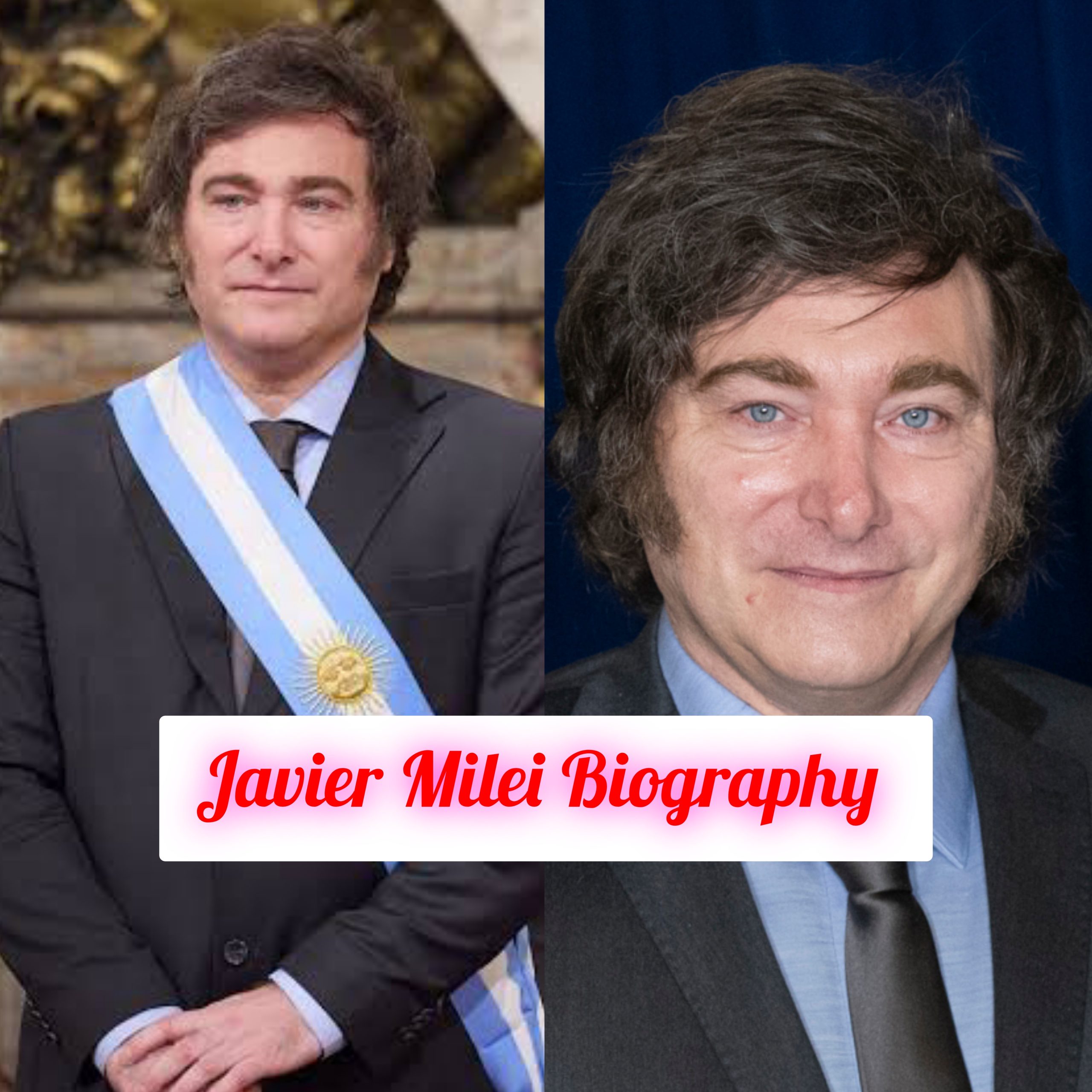
Javier Milei Biography: Age, Early Life, Education, Personal Life, Family, Career, Awards, Philosophy, Achievements, Legacy, Net Worth
Javier Milei Biography
Javier Gerardo Milei rose from a troubled childhood in Buenos Aires to become one of the most unconventional political figures in modern Latin American history. An economist by training and a well known fierce critic of state intervention, he built a public profile through sharp television appearances before launching a rapid political ascent that culminated in his election as president of Argentina in 2023. His blend of academic rigor, theatrical style, and uncompromising free-market convictions has made him a polarizing yet transformative presence on the national and international stage.
His story reflects both personal resilience and the deep economic frustrations that have long shaped Argentine public life. From the neighborhoods of Palermo and Villa Devoto to the Casa Rosada, Milei has consistently framed his mission as a defense of individual liberty against what he calls a parasitic political caste.
Javier Gerardo Milei was born in Palermo, Buenos Aires, Argentina. He holds Argentine nationality and also Italian citizenship by descent.
Javier Milei Early Life
Javier Gerardo Milei was born on 22 October 1970 in the Palermo neighborhood of Buenos Aires. He spent his early years in the upper-middle-class area of Villa Devoto and later lived in Sáenz Peña in the Tres de Febrero district. His father, Norberto Horacio Milei, began as a bus driver and later built a successful career in passenger transport companies. His mother, Alicia Luján Lucich, worked as a homemaker. The family has Italian roots on the paternal side, with grandparents and great-grandparents from Calabria and Basilicata, and mixed Croatian, Italian, and Jewish ancestry on the maternal side. Milei has spoken publicly about discovering that a maternal grandfather learned late in life of Jewish matrilineal descent.
Milei has described his childhood as marked by physical and verbal abuse from both parents. He has recounted severe beatings from his father and constant belittling, including predictions that he would amount to nothing. The experience led him to cut contact with his parents for roughly a decade as a young adult. He has credited the hardship with building personal resilience. Emotional support during those years came primarily from his maternal grandmother and his younger sister, Karina Milei, with whom he maintained an exceptionally close bond.
He attended Catholic schools, including Cardenal Copello secondary school in Villa Devoto. Classmates and later biographers recall a reserved yet intense student who earned the nickname “El Loco” for his passionate outbursts and unconventional manner. Outside school he pursued two strong interests. As a teenager he played goalkeeper for the youth and then professional squads of Chacarita Juniors between the mid-1980s and 1989. Teammates remembered him as fearless and physically strong. He also sang and played in a Rolling Stones cover band called Everest, performing in neighborhood bars in Palermo.
The severe hyperinflation of the late 1980s, including scenes of people rushing supermarket shelves, deeply affected him. At around age eighteen he decided to abandon football and music in favor of economics, seeking to understand the forces that had destabilized everyday life in Argentina.
Javier Milei Personal Life
Milei has never married and has no children. He has maintained a private personal sphere while occasionally acknowledging romantic relationships. In the late 2010s he was linked to singer Daniela Mori. In 2023 he publicly confirmed a relationship with actress and impersonator Fátima Flórez. Other brief associations have been reported over the years, yet he has consistently emphasized that his closest emotional ties remain with his sister and his dogs.
Karina Milei occupies a central place in his life. He frequently refers to her as “the boss” and has described her as the most important person around him. She has served as his closest confidante, political organizer, and later as Secretary General of the Presidency. Their bond was forged in childhood when she intervened during episodes of family conflict. Both siblings have remained unmarried and childless, channeling familial affection toward their pets.
Milei’s relationship with animals is well documented and unusually intense. His English mastiff Conan, whom he called his son, died in 2017. Milei arranged for the cloning of Conan in the United States, resulting in several offspring that he named after economists he admires: Murray (Rothbard), Milton (Friedman), Robert, and Lucas. He has referred to the dogs as his four-legged children and has spoken of seeking advice from them. Reports have described his hiring of a specialist in interspecies communication during the period surrounding Conan’s death and the early years with the clones. Karina Milei is also said to have taken an interest in related practices. The dogs remain a protected part of his private world; official spokespeople have discouraged intrusive questions about them.
Milei has spoken of a spiritual dimension to his life that includes respect for Jewish tradition and an affinity for certain biblical narratives of liberation. He has visited synagogues, expressed admiration for Israel, and received honors from Jewish organizations. At the same time he has remained critical of institutional religion when he believes it interferes with individual freedom.
Javier Milei Age
As of October 2026 Javier Milei is 56 years old. He was born on 22 October 1970 and celebrated his fifty-sixth birthday while returning from an official visit to Spain and continuing his third year in the presidency.
Javier Milei Education
Milei enrolled at the University of Belgrano, a private institution in Buenos Aires, and earned a licentiate degree in economics. He completed the program with a high academic average reported at 9.43 out of 10. During his studies he interned at the Central Bank of Argentina. He initially approached economics through a neoclassical and Keynesian lens common in Argentine universities at the time.
He later pursued postgraduate coursework at the Instituto de Desarrollo Económico y Social and at Torcuato di Tella University. Sources differ on whether these programs resulted in completed master’s degrees; some accounts state that he obtained two master’s degrees while others, including university statements, indicate that the coursework did not culminate in formal degrees. Regardless of the exact credentials, the additional study deepened his exposure to economic theory.
Around 2013 Milei encountered the works of the Austrian School, particularly Murray Rothbard. The encounter produced what he has described as a profound intellectual conversion. He rejected much of the neoclassical framework he had previously taught and embraced Austrian praxeology, methodological individualism, and free-market principles. He has credited mentors such as Alberto Benegas Lynch Jr. and Jesús Huerta de Soto with refining his understanding. Over subsequent years he taught macroeconomics, growth economics, microeconomics, and mathematics for economists at several Argentine universities and published academic papers and books advancing Austrian and libertarian ideas.
Javier Milei Career
Academic and Private-Sector Work
After completing his undergraduate studies Milei entered the private sector. He worked as an economist at HSBC Argentina and later as chief economist at Máxima AFJP, a private pension fund created during the 1990s reforms. He also collaborated with the consulting firm of Miguel Ángel Broda. For approximately fifteen years he served as chief economist and financial adviser at Corporación América, the holding company of businessman Eduardo Eurnekian. In that role he analyzed markets, advised on investments, and developed a practical understanding of business under Argentina’s volatile economic conditions.
Parallel to his corporate work he built an academic career, teaching at universities and producing articles on economic growth and policy. By the mid-2010s he had become a frequent presence on television and radio. Programs on channels such as A24 and América TV featured his forceful critiques of successive governments, high public spending, and what he termed the political caste. He hosted the radio show Demoliendo Mitos, where he discussed free-market ideas with like-minded guests. Rankings of media appearances placed him among the most interviewed economists in Argentina.
Entry into Politics and Legislative Service
Milei entered formal politics in 2021. He first associated with the Avanza Libertad coalition before founding La Libertad Avanza. Running for a seat in the Chamber of Deputies representing the City of Buenos Aires, he campaigned on a platform of radical spending cuts, opposition to new taxes, and rejection of the traditional political class. His slogan emphasized awakening lions rather than leading sheep. He won a seat with a strong showing in the capital and assumed office on 10 December 2021.
As a national deputy he maintained a low legislative profile, focusing instead on public criticism. He raffled his monthly salary each month, describing it as money taken by force from citizens, and donated the proceeds. He introduced little legislation and rarely participated in committees, preferring television and social media as his main arenas. Investigations into alleged irregularities in candidate selection within his coalition were opened and later closed for lack of evidence.
Presidential Campaign and Election
In 2023 Milei launched a presidential bid under the La Libertad Avanza banner. His campaign centered on ending Argentina’s chronic fiscal deficits, reducing the size of the state, dollarizing the economy or eliminating the central bank, and confronting the legacy of Kirchnerism. He used distinctive symbols such as a chainsaw to represent cuts in public spending. In the August primaries he surprised observers by finishing first. In the October general election he advanced to a runoff against Economy Minister Sergio Massa. On 19 November 2023 he won the runoff with approximately 55.7 percent of the vote, the highest share for a presidential candidate since the return of democracy in 1983. He was inaugurated on 10 December 2023.
Presidency
Upon taking office Milei moved quickly to implement austerity. He reduced the number of ministries, cut public spending sharply, devalued the peso, removed many price controls and subsidies, and pursued deregulation. Official statistics later showed a sharp decline in monthly inflation, the achievement of a primary fiscal surplus for the first time in many years, and a reduction in measured poverty rates by early 2025, although real wages and consumption remained under pressure in several sectors. His coalition strengthened its position in the 2025 legislative elections. Internationally he oriented foreign policy toward closer ties with the United States and Israel while distancing Argentina from certain multilateral alignments. He has continued to travel extensively, receiving awards and promoting his vision of economic freedom.
Javier Milei Family
Milei’s immediate family consists of his parents, Norberto Horacio Milei and Alicia Luján Lucich, and his sister Karina. Relations with his parents were severely strained for many years. He has publicly described physical and psychological mistreatment during childhood and adolescence and for a long period considered them effectively dead to him. A reconciliation occurred around the time of his entry into national politics; both parents later appeared at campaign events. The relationship remains complex according to his own statements.
Karina Milei is the central family figure in his adult life. Born in 1973, she studied public relations and protocol, worked in administrative roles, and later managed aspects of her brother’s career. She has held formal positions within La Libertad Avanza and the executive branch. Milei has repeatedly stated that he would be lost without her guidance and has compared their partnership to biblical figures of complementary roles. Neither sibling has children of their own. Their shared household focus has long included the care of the mastiff dogs that Milei regards as family.
Extended family includes Italian and Croatian ancestors who immigrated to Argentina in earlier generations. Milei has expressed particular affection for the memory of his maternal grandmother, who provided emotional shelter during difficult years.
Javier Milei Philosophy
Milei’s intellectual framework rests on the Austrian School of economics and the political philosophy of anarcho-capitalism. He identifies as a minarchist in the short term, favoring a minimal state limited to essential security functions, and as an anarcho-capitalist in the long term, envisioning a society in which virtually all services arise through voluntary exchange and private property. He regards taxation as coercive and many forms of state intervention as violations of individual rights.
Key influences include Ludwig von Mises, Friedrich Hayek, and especially Murray Rothbard, whose ethical and economic arguments against the state shaped Milei’s conversion around 2013. He frequently cites Alberto Benegas Lynch Jr.’s definition of liberalism as unrestricted respect for the life project of others grounded in the non-aggression principle and the defense of life, liberty, and property. He draws additional inspiration from classical liberal and Judeo-Christian traditions, viewing the biblical Exodus as a foundational story of liberation.
In policy terms this philosophy translates into opposition to deficit spending, central banking as currently practiced, price controls, extensive welfare programs, and what he terms cultural Marxism or woke ideology. He supports free trade, private property, civilian firearm ownership, and individual choice on many personal matters while opposing abortion and euthanasia on ethical grounds. He has argued that true social justice consists in allowing individuals to keep the fruits of their labor rather than redistributing them through state mechanisms.
Javier Milei Achievements
As an academic and commentator Milei produced books and articles that popularized Austrian economics in Argentina, including works such as El camino del libertario. His media presence made free-market ideas accessible to a broad audience previously dominated by other schools of thought.
Politically his most visible achievements are the rapid electoral success of La Libertad Avanza and the early macroeconomic results of his presidency. Official data from INDEC and related agencies recorded a steep drop in inflation from the hyperinflationary levels of 2023, the restoration of a fiscal surplus, and measurable declines in poverty rates by 2025. Legislative gains in 2025 expanded his coalition’s influence. Internationally he has repositioned Argentina’s foreign policy toward Western partners and received recognition for support of Israel and free-enterprise principles.
These results remain subject to debate. Critics point to social costs including reduced public services, pressures on real incomes, and sectoral difficulties. Supporters emphasize the break with decades of fiscal imbalance and the restoration of basic macroeconomic stability as a necessary foundation for future growth.
Javier Milei Awards
Since assuming the presidency Milei has received numerous international honors. These include the Genesis Prize, often described as a Jewish Nobel, awarded in 2025 for his support of Israel and economic reforms. He received Israel’s Presidential Medal of Honor from President Isaac Herzog in 2026, along with an honorary doctorate from Bar-Ilan University. Other distinctions encompass the Global Champion of Free Enterprise from the United States Chamber of Commerce, the Ludwig von Mises Medal from the German Mises Institute, the Röpke Prize, the Juan de Mariana Prize, the Torch of Freedom, the B’nai B’rith Presidential Gold Medal, and multiple honorary doctorates and medals from European and Latin American institutions. By late 2026 reports indicated he had accumulated more than thirty such recognitions, many linked to his defense of free markets and Western values.
Javier Milei Current News
As of October 2026 Milei continues to govern amid ongoing economic adjustment. Recent asset declarations showed his personal wealth rising nominally by about 43 percent in 2025, largely through revaluation of existing property rather than new acquisitions, leaving his net position modest by presidential standards. He has undertaken high-profile international trips, including visits to Spain and the United States, where he collected additional awards and defended his record. Domestic debate centers on the pace of recovery, unemployment figures, business closures in some sectors, and the social impact of austerity. Midterm electoral results in 2025 strengthened his legislative position, allowing further reforms. Public discussion also continues around his personal style, the role of his sister in government, and the long-term sustainability of the fiscal and monetary path he has chosen.
Javier Milei Net Worth
Verified figures from Argentina’s Anti-Corruption Office show that at the end of 2025 Milei declared assets totaling approximately 295 million Argentine pesos. This represented a nominal increase of roughly 43 percent from the previous year, driven mainly by updated valuations of a Buenos Aires apartment owned since 2000 and existing vehicles. Converted at official exchange rates the sum equated to roughly 200,000 United States dollars. Earlier declarations upon taking office and during his time as deputy indicated still lower figures. Income sources include the presidential salary, book royalties, and residual professional earnings. No credible evidence of substantial undeclared wealth has been presented in official records. Estimates circulating in secondary sources that place his fortune in the millions of dollars appear inconsistent with the sworn declarations.
Conclusion
Javier Milei’s trajectory from a childhood of hardship in Buenos Aires to the presidency of Argentina illustrates the power of ideas combined with personal determination and political timing. His embrace of Austrian economics and anarcho-capitalist principles offered a clear alternative to decades of fiscal excess and inflation. Whether his reforms will produce lasting prosperity remains an open question that future economic data will answer. What is already evident is that he has altered the terms of Argentine political debate and placed questions of state size, individual liberty, and monetary discipline at the center of national conversation. His story continues to unfold as he navigates the practical constraints of governing while remaining committed to the philosophical vision that first brought him to public attention.
FAQs
Who is Javier Milei?
Javier Gerardo Milei is an Argentine economist and politician who has served as president of Argentina since 10 December 2023. He previously served as a national deputy from 2021 to 2023 and is known for his libertarian and anarcho-capitalist views.
When and where was Javier Milei born?
He was born on 22 October 1970 in the Palermo neighborhood of Buenos Aires, Argentina.
What is Javier Milei’s educational background?
He earned a licentiate degree in economics from the University of Belgrano and completed postgraduate coursework at the Instituto de Desarrollo Económico y Social and Torcuato di Tella University.
What is Javier Milei’s political ideology?
He identifies as a libertarian aligned with the Austrian School of economics. Philosophically he describes himself as an anarcho-capitalist in the long term and a minarchist in the short term, advocating minimal government and free markets.
Does Javier Milei have a family?
He is unmarried and has no children. His closest relative is his sister Karina Milei, who holds a senior position in his government. He maintains a strong attachment to his English mastiff dogs, several of which were cloned from a previous pet named Conan.
What are some of Javier Milei’s major policy achievements?
His administration achieved a primary fiscal surplus, sharply reduced monthly inflation from hyperinflationary levels, and recorded declines in official poverty rates by early 2025, alongside extensive deregulation and spending cuts.
Has Javier Milei received awards?
Yes. Notable honors include the Genesis Prize, Israel’s Presidential Medal of Honor, the Global Champion of Free Enterprise award, the Ludwig von Mises Medal, and numerous other distinctions from free-market and international organizations.
What is known about Javier Milei’s net worth?
According to official asset declarations filed with Argentine authorities, his declared wealth at the end of 2025 stood at approximately 295 million Argentine pesos, equivalent to roughly 200,000 United States dollars at official exchange rates, consisting mainly of a Buenos Aires apartment and vehicles.