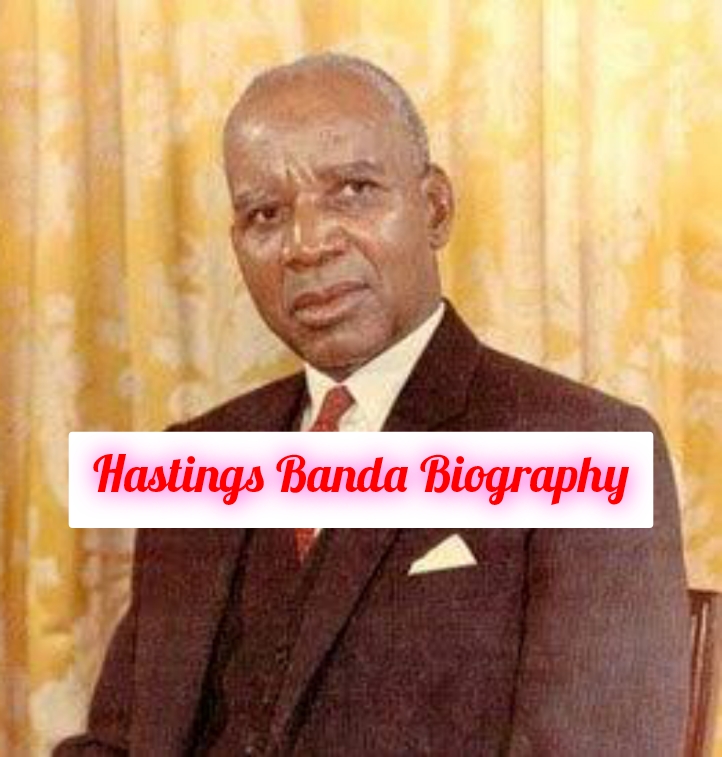
Hastings Banda Biography: Age, Personal Life, Early Life, Career, Awards, Family, Achievement, Philosophy, Legacy, Death, Net Worth
Hastings Banda Biography
Hastings Kamuzu Banda rose from rural roots in colonial central Africa to become the founding leader of independent Malawi. Trained as a well known medical doctor in the United States and Britain, he spent decades abroad before returning home to spearhead the nationalist struggle against British rule and the unpopular Central African Federation. His political career transformed Nyasaland into the Republic of Malawi and placed him at the centre of the new nation’s government for three decades.
Banda combined a conservative economic approach focused on agriculture and infrastructure with tightly centralized political control. He guided the country through its early years of statehood while enforcing strict social codes and suppressing dissent. His long tenure left a complex legacy that continues to shape discussions of Malawian nationhood.
Hastings Kamuzu Banda was born near Kasungu in what was then the British Central Africa Protectorate, later known as Nyasaland and today as Malawi. He was Malawian by nationality.
Hastings Banda Early Life
Hastings Kamuzu Banda was born around 1898 near Kasungu in the British Central Africa Protectorate. No official birth records existed at the time, so the precise date remains uncertain. Banda himself often gave 14 May 1906 as his birthday, yet later accepted evidence placing his birth in March or April 1898. His original name was Akim Kamnkhwala Mtunthama Banda. The name Kamuzu, meaning “little root,” came from a local tradition: his mother had received root herbs from a medicine man to overcome infertility before conceiving him. He later adopted the Christian name Hastings in honour of a Scottish missionary he admired.
His parents, Mphonongo Banda and Akupingamnyama Phiri, were subsistence farmers of the Chewa ethnic group. The family lived by cultivating small plots of land. As a young child Banda received a piece of ground to work with a hoe, learning the rhythms of rural life early. He attended a village school near Mtunthama and later moved to his maternal grandparents’ home, where he continued at Chayamba Primary School in Chikondwa. In 1908 he entered the Chilanga mission station run by the Church of Scotland. He was baptised in 1910 by Dr George Prentice and took the name Hastings.
Around 1915 or 1916, in his mid to late teens, Banda left home on foot with an uncle, Hanock Msokera Phiri, who had taught at a Livingstonia mission school. They walked to Hartley in Southern Rhodesia, now Chegutu in Zimbabwe. Banda hoped to enrol at the Lovedale Missionary Institute in South Africa but completed further schooling elsewhere. In 1917 he continued on foot to Johannesburg. There he worked for several years at the Witwatersrand Deep Mine on the Transvaal Reef, performing various tasks including clerical duties and interpreting. During this period he joined the African Methodist Episcopal Church and met Bishop William Tecumseh Vernon, who later helped arrange his passage to the United States.
These early years of migration, manual labour, and exposure to mission education formed the foundation of Banda’s determination to seek higher learning far beyond the limited opportunities available in colonial central Africa.
Hastings Banda Personal Life
Banda maintained a largely private personal life shaped by long periods abroad and later by the demands of political power. While studying medicine at Meharry Medical College in Tennessee, he married Robertine Edmonds in 1934. The marriage produced no children and appears to have ended without public record of lasting partnership.
During his years practising medicine in northern England, Banda formed a relationship with Merene French, the daughter-in-law of one of his patients. Reports indicate she became pregnant, though this has never been fully confirmed in public records. Banda was named as co-respondent in a divorce case involving adultery. French followed him to the Gold Coast, now Ghana, but the relationship ended. He later turned away from any further association with her. She died in 1976. Claims later emerged that a son named Jumani Johansson was born from this relationship; Johansson sought DNA testing through Malawian courts in 2010 but the matter remained unresolved at the time of his own death in 2019.
After returning to Nyasaland, Banda never married again. Cecilia Tamanda Kadzamira, a nurse who had worked in his medical practice in Blantyre, became his closest companion and the country’s Official Hostess, often referred to as Mama of the Nation. She managed access to him, influenced many decisions in his later years, and accompanied him on state occasions. Their relationship was presented publicly as platonic, though they maintained adjacent private quarters in official residences. Kadzamira wielded considerable influence, particularly through the women’s organisation she founded, and remained at his side until his final years.
Banda lived simply in many personal habits. He was a teetotaller and held strict views on morality and dress that later became national policy. In private he was described by some who knew him in old age as lonely, despite the constant presence of aides and officials.
Hastings Banda Age
Because no birth certificate existed, Banda’s exact age at death cannot be stated with certainty. Official sources during his lifetime listed his birthday as 14 May 1906. Most historical accounts place his birth around 1898, making him approximately 99 years old when he died on 25 November 1997 in Johannesburg, South Africa. His death certificate recorded an age consistent with the earlier birth year. The discrepancy between the official and more widely accepted dates reflects both the absence of colonial records and Banda’s own occasional preference for the later year.
Hastings Banda Education
Banda’s formal education began in mission schools in the Kasungu area under the Church of Scotland. After leaving Nyasaland he continued basic studies while working in Southern Rhodesia and South Africa. In 1925 he sailed to the United States, sponsored in part by Bishop Vernon of the African Methodist Episcopal Church.
He completed secondary studies at the high school section of Wilberforce Institute in Ohio, now Central State University, graduating in 1928. With financial support from benefactors including Mrs Smith, whose husband had made money from patent medicines, he enrolled as a pre-medical student at Indiana University. After four semesters he transferred to the University of Chicago, where he studied history and political science and collaborated with anthropologist Mark Hanna Watkins on a grammar of the Chewa language. He graduated with a Bachelor of Philosophy degree in 1931.
Banda then entered Meharry Medical College in Nashville, Tennessee, an institution that trained African American physicians. He received his Doctor of Medicine degree in 1937, becoming only the second Malawian to earn a medical qualification after Daniel Sharpe Malekebu.
To practise in British territories he needed further credentials. He enrolled at the University of Edinburgh and obtained the Scottish triple conjoint diploma, allowing him to use the post-nominals LRCP(Edin), LRCS(Edin) and LRCPSG, in 1941. His studies were supported by stipends from the Nyasaland government and the Church of Scotland. He also completed courses in tropical medicine. During this period he became an elder in a Church of Scotland parish.
This extensive education across two continents equipped Banda with medical skills and a broad understanding of history, politics, and language that later informed his nationalist leadership.
Hastings Banda Career
Medical Practice Abroad
After qualifying in Edinburgh, Banda worked as a doctor in North Shields near Newcastle upon Tyne between 1941 and 1945. He later established a successful general practice in the London suburb of Harlesden. Patients valued his careful attention, and the practice provided financial independence. During these years he remained connected to Nyasaland politics through correspondence and representation of the Nyasaland African Congress at the Fifth Pan-African Congress in Manchester in 1945, where he met future leaders such as Jomo Kenyatta and Kwame Nkrumah.
In 1953, following the creation of the Federation of Rhodesia and Nyasaland, which he strongly opposed, Banda moved to the Gold Coast. There he continued medical practice while watching political developments at home.
Nationalist Leadership and Independence
In 1958, after repeated appeals from Congress leaders including Henry Chipembere and Kanyama Chiume, Banda returned to Nyasaland after an absence of roughly forty-two years. Crowds welcomed him enthusiastically. He assumed leadership of the Nyasaland African Congress and toured the country denouncing the Federation. His speeches, often delivered through interpreters because he had grown less fluent in Chichewa, stirred widespread support.
In March 1959 the colonial authorities declared a state of emergency and arrested Banda along with hundreds of others in Operation Sunrise. He was detained in Gwelo, Southern Rhodesia. Released in April 1960, he immediately entered talks with British officials. His party, renamed the Malawi Congress Party, won the 1961 elections. Banda served as Minister of Natural Resources and Local Government before becoming Prime Minister of Nyasaland in February 1963. The Federation dissolved that year.
On 6 July 1964 Nyasaland became independent as Malawi, with Banda as Prime Minister. He had chosen the new name after seeing “Lake Maravi” on an old map.
Presidency and Consolidation of Power
A cabinet crisis erupted within weeks of independence when several ministers challenged Banda’s growing authority and foreign policy. He dismissed four ministers; others resigned. The dissidents fled into exile. In 1966 Malawi became a republic and Banda was elected its first President, the only candidate. The new constitution made the Malawi Congress Party the sole legal party and granted the president extensive powers.
In 1970 the party declared Banda its life president. In 1971 Parliament made him President for Life of the republic. He held multiple portfolios including external affairs, defence, agriculture, and justice. His government invested in roads, hospitals, schools, and cash-crop agriculture, particularly tobacco. Malawi maintained diplomatic and trade links with apartheid South Africa and Portuguese Mozambique, positions that drew criticism from other African states but provided practical economic benefits for the landlocked country.
Banda founded Kamuzu Academy, modelled on British public schools, where students studied Latin and Greek. He enforced strict dress codes prohibiting women from wearing trousers or short skirts and men from growing long hair. Political opposition was suppressed through detention, exile, and, according to human rights estimates, thousands of deaths. The Malawi Young Pioneers served as a parallel security force loyal to him.
By the early 1990s domestic protests, a critical pastoral letter from Catholic bishops, and pressure from international donors forced change. A 1993 referendum ended one-party rule. In the multiparty elections of May 1994 Banda lost to Bakili Muluzi and left office peacefully.
Hastings Banda Family
Banda’s immediate family remained limited. His marriage to Robertine Edmonds produced no children. The relationship with Merene French is the only known source of possible offspring, though claims by Jumani Johansson were never conclusively verified. Cecilia Kadzamira functioned as the central figure in his later domestic and public life, managing households and political access. Her relatives, including uncle John Tembo, held influential positions. Banda’s estate was later administered by family members, among them a grand-niece, Jane Dzanjalimodzi. He left no direct acknowledged heirs.
Hastings Banda Philosophy
Banda’s outlook combined Presbyterian moral discipline with a pragmatic view of African development. He believed firm authority and hard work were necessary to lift a rural population out of poverty. He rejected both radical socialism and pure Western liberalism, preferring what he saw as practical cooperation with any partner that advanced Malawi’s interests. This led him to maintain relations with South Africa while publicly supporting pan-African ideals in limited form. He emphasised education, agricultural self-reliance, and social order. In speeches he often described the people of Malawi as needing guidance, reflecting a paternalistic approach shaped by his long absence and medical training. His personal austerity and insistence on obedience became national policy under the banner of what some called Kamuzuism.
Hastings Banda Achievements
Banda’s most lasting achievement was leading Nyasaland to independence and establishing the institutional framework of the Malawian state. He expanded secondary education, improved transport networks, and promoted cash-crop farming that generated foreign exchange. The founding of Kamuzu Academy created a centre of academic excellence that continues to produce professionals. His government maintained relative economic stability for much of the 1960s and 1970s compared with some neighbouring states. He navigated Cold War pressures by aligning with Western donors while avoiding open conflict with regional powers. The peaceful transfer of power in 1994, after decades of personal rule, marked a rare orderly transition in the region at that time.
Hastings Banda Awards
Banda received several formal honours during his presidency. In Malawi he held the title Grand Commander of the Order of the Lion. Taiwan awarded him the Grand Cordon of the Order of Brilliant Jade and the Key to the City of Taipei in 1967. In 1985 the United Kingdom conferred the honorary rank of Knight Grand Cross of the Order of the Bath. These decorations recognised his role as head of state and his diplomatic contacts rather than specific individual accomplishments outside government.
Hastings Banda Net Worth
During his years in power Banda is believed to have accumulated substantial personal assets, with some estimates placing the figure at around 320 million United States dollars invested in agriculture, property, and mining interests, particularly in South Africa. Later reports on his estate after leaving office suggested a more modest valuation of approximately 50 million dollars, including commercial properties and shares. Exact figures remain unverified because of the opaque nature of financial holdings under the one-party system. The wealth was managed by family members after his death.
Conclusion
Hastings Kamuzu Banda’s life spanned the final decades of colonial rule and the first generation of African independence. From a rural Chewa childhood and years of labour in southern African mines, he acquired an advanced medical education and returned to lead his people to nationhood. As president he built infrastructure and educational institutions while concentrating power in his own hands and enforcing rigid social controls. His rule ended through electoral defeat rather than violence, allowing Malawi to begin a new chapter of multiparty democracy. The record of his leadership continues to invite careful examination of the costs and benefits of personal authority in the early years of an independent African state.
FAQs
What was Hastings Banda’s full name and place of birth?
His full name was Hastings Kamuzu Banda. He was born near Kasungu in the British Central Africa Protectorate, now Malawi.
When did Hastings Banda die and how old was he?
He died on 25 November 1997 in Johannesburg, South Africa. Most accounts place his age at approximately 99 years.
What was Hastings Banda’s profession before politics?
He was a qualified medical doctor who practised in England and the Gold Coast after training in the United States and Scotland.
How long did Hastings Banda rule Malawi?
He led the country from independence in 1964 until 1994, serving first as prime minister and then as president, including a period as president for life.
Did Hastings Banda have children?
He had no confirmed children from his marriage. Claims of a son from a relationship in Britain have not been conclusively verified.
What is Hastings Banda’s legacy in Malawi?
He is remembered as the founder of the independent nation and builder of early infrastructure, while also being associated with authoritarian rule and human rights restrictions.