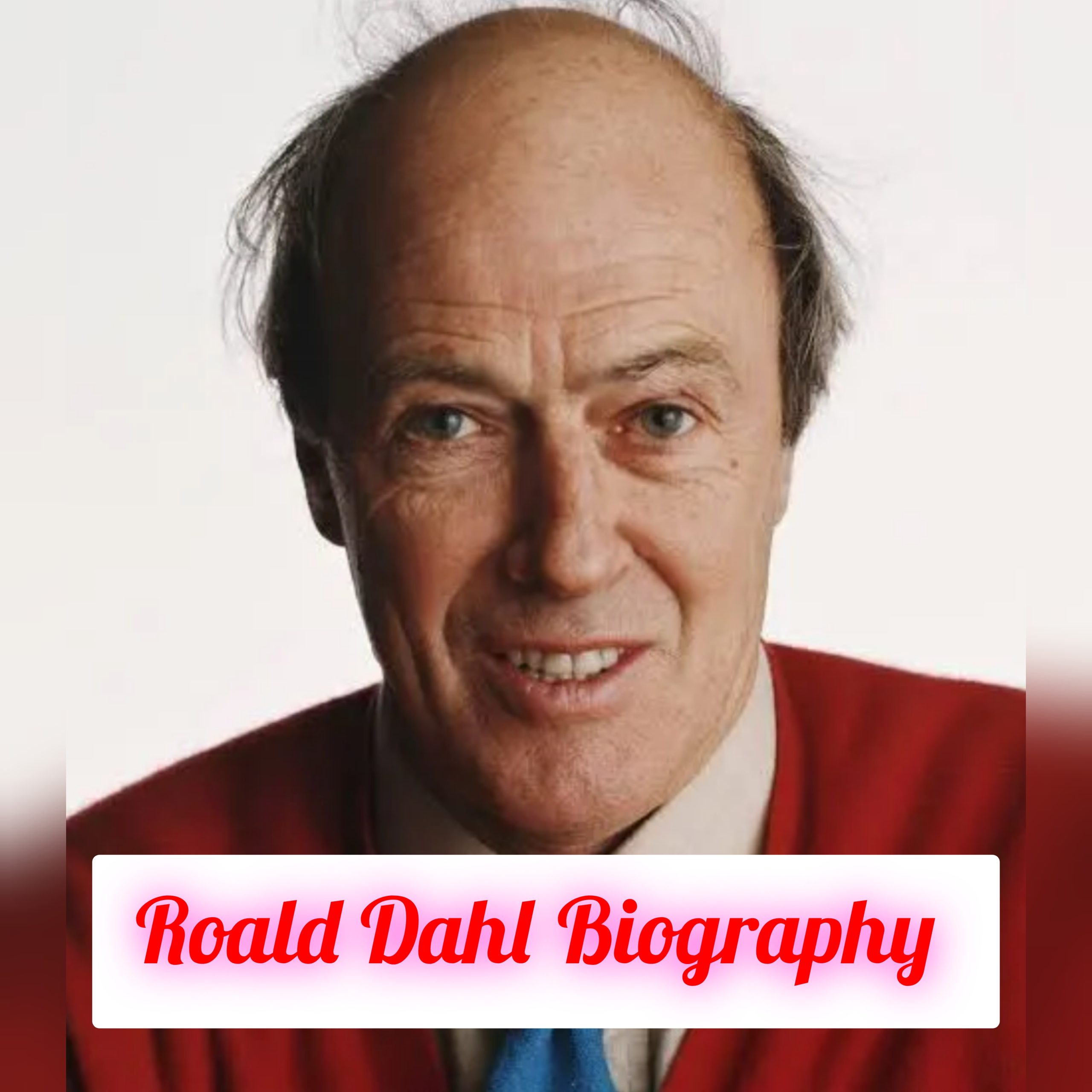
Roald Dahl Biography: Early Life, Personal Life, Age, Education, Family, Career, Awards, Achievements, Legacy, Net Worth
Roald Dahl Biography
Roald Dahl remains one of the most widely read storytellers of the twentieth century, a writer whose tales of inventive children, grotesque adults, and unexpected twists continue to captivate readers across generations. His books blend sharp humour, dark edges, and a deep understanding of how the world looks from a child’s point of view. Through novels such as Charlie and the Chocolate Factory, Matilda, and The BFG, he created worlds that feel both fantastical and strangely familiar, worlds where justice is often delivered in the most inventive ways.
Dahl’s life itself reads like one of his stories. Born to Norwegian parents in Wales, he experienced early family loss, harsh schooling, wartime flying, and a later career that moved from adult short stories into children’s literature of lasting influence. His work has sold hundreds of millions of copies and inspired stage, film, and television adaptations that keep his imagination alive for new audiences.
Roald Dahl was born in Llandaff, Cardiff, Wales, and held British nationality.
Roald Dahl Early Life
Roald Dahl was born on 13 September 1916 at Villa Marie on Fairwater Road in Llandaff, a district of Cardiff in Wales. His parents were Norwegian immigrants. His father, Harald Dahl, was a prosperous shipbroker who had settled in Cardiff in the 1880s. His mother, Sofie Magdalene Hesselberg, had come later from Norway. The family spoke Norwegian at home and maintained strong ties to their heritage. Dahl was named after the celebrated Norwegian polar explorer Roald Amundsen. He had several sisters, including Astri, Alfhild, Else, and Asta.
Tragedy struck the household when Dahl was only three years old. In 1920 his older sister Astri died of appendicitis. Only weeks later his father died of pneumonia. Sofie was pregnant with the youngest daughter at the time. Despite the option of returning to Norway, she chose to remain in Britain so that her children could receive an English education, fulfilling her late husband’s wish.
The young Dahl grew up in a household shaped by both Norwegian traditions and the practical realities of life in Wales. Summers often included visits to relatives in Norway, where he absorbed folk tales of witches, trolls, and magical creatures that would later colour his own storytelling. The family eventually moved to a large farmhouse called Ty Mynydd in Radyr, near Cardiff, a place Dahl remembered with affection for its open countryside.
His earliest schooling began at Elm Tree House Primary School and then the Cathedral School in Llandaff. At the age of eight he and a group of friends played a practical joke involving a dead mouse placed in a jar of sweets at a local sweet shop run by a woman he later described as mean. The headmaster caned the boys as punishment. Dahl’s mother, angered by the severity of the beating, removed him from the school and sent him to a boarding school in England, following the path her husband had preferred.
Roald Dahl Personal Life
Dahl’s adult personal life was marked by both public success and private hardship. In 1953 he married the American actress Patricia Neal in New York. The couple had five children: Olivia, Tessa (sometimes known as Chantal Sophia), Theo, Ophelia, and Lucy. Their marriage lasted three decades but was strained by successive family crises and by Dahl’s own demanding personality.
In 1960 their infant son Theo was severely injured when his pram was struck by a taxi in New York. The accident left Theo with lasting neurological effects. Two years later their eldest daughter Olivia died at the age of seven from measles encephalitis. Dahl was deeply affected by the loss and later became a strong advocate of vaccination. In 1965 Patricia Neal suffered a series of devastating strokes while pregnant with their fifth child. Dahl supervised an intensive programme of rehabilitation that helped her regain much of her speech and mobility.
The marriage ended in divorce in 1983. Later that same year Dahl married Felicity Crosland, known as Liccy, a British film producer who had been a family friend. The second marriage brought a period of greater personal stability in his final years. Dahl lived for many decades at Gipsy House in the village of Great Missenden in Buckinghamshire, where he wrote most of his later books in a small garden hut.
He was known among friends and family as a complex figure: generous and inventive at times, yet also capable of sharp judgements and difficult behaviour. He collected paintings and antiques, and he maintained a lifelong interest in practical inventions and problem solving.
Roald Dahl Age
Roald Dahl was born on 13 September 1916 and died on 23 November 1990. He lived to the age of 74. In the final year of his life he was diagnosed with myelodysplastic syndrome, a rare blood disorder affecting the bone marrow. He died in the John Radcliffe Hospital in Oxford and was buried in the churchyard of St Peter and St Paul in Great Missenden.
Roald Dahl Education
Dahl’s formal education took place entirely within the English boarding school system after his early years in Wales. Following the incident at the Cathedral School in Llandaff, his mother enrolled him at St Peter’s Preparatory School in Weston-super-Mare. He was homesick and wrote frequent letters home, though he rarely revealed the full extent of his unhappiness.
At the age of thirteen he moved to Repton School in Derbyshire, a well known public school. He remained there until 1934. Repton left a lasting impression on him, much of it negative. He disliked the rigid hierarchy, the system of younger boys serving older ones, and the culture of physical punishment. He later wrote that the hypocrisy of harsh discipline followed by pious chapel services cured him of any strong attachment to organised religion.
Academic results at Repton were mixed. Dahl was not regarded as an outstanding student, though he excelled in sports and showed an early talent for observation and storytelling. One memorable feature of school life was the regular arrival of sample chocolate bars from the Cadbury company for the boys to taste and evaluate. The experience of ranking new chocolates stayed with him and later provided part of the inspiration for Charlie and the Chocolate Factory.
After leaving Repton he declined the chance of university, even though his mother was prepared to support further study. He preferred adventure and practical work over academic life.
Roald Dahl Career
Early Adventures and Wartime Service
After school Dahl joined the Public Schools Exploring Society on an expedition to Newfoundland. He then took a position with the Shell Oil Company. Following training in Britain he was posted to East Africa, working in Dar es Salaam in what was then Tanganyika (now Tanzania). The posting satisfied his desire for distant places and independent responsibility.
When the Second World War began in 1939 he drove across country to Nairobi and enlisted in the Royal Air Force. After pilot training he flew Gladiator biplanes and later Hurricanes. In 1940 he crash landed in the Libyan desert after a navigational error. The accident left him with serious injuries, including temporary blindness and lasting spinal damage. He recovered sufficiently to return to flying and served in Greece and Syria before being posted to Washington in 1942 as assistant air attaché. While in the United States he also carried out intelligence work for British authorities.
Transition to Writing
In Washington the novelist C. S. Forester encouraged him to write about his flying experiences. Dahl’s account of the Libyan crash was published in the Saturday Evening Post and marked the start of his literary career. His first book, The Gremlins, appeared in 1943 and was written for Walt Disney, though a planned film never materialised. A collection of wartime flying stories, Over to You, followed in 1946.
In the 1950s Dahl established himself as a writer of adult short stories. Collections such as Someone Like You (1953) and Kiss Kiss (1959) featured macabre plots, dark humour, and unexpected endings. Several stories were adapted for television, including the series Tales of the Unexpected. He also wrote screenplays, most notably for the James Bond film You Only Live Twice (1967) and the children’s film Chitty Chitty Bang Bang (1968).
Children’s Literature
The shift toward children’s books began in earnest with James and the Giant Peach, published in 1961. Written initially for his own children, the story of a boy who escapes his cruel aunts inside a giant peach became an immediate success. Charlie and the Chocolate Factory followed in 1964 and quickly became one of his best known works. Subsequent titles included Fantastic Mr Fox (1970), Danny, the Champion of the World (1975), The Enormous Crocodile (1978), The Twits (1980), George’s Marvellous Medicine (1981), The BFG (1982), The Witches (1983), and Matilda (1988).
These books share a consistent set of qualities: inventive language, strong plots, child protagonists who outwit unpleasant adults, and a refusal to talk down to young readers. Dahl wrote most of them in the writing hut at Gipsy House, working with great discipline and revising carefully. His collaboration with the illustrator Quentin Blake produced some of the most recognisable pairings of text and image in modern children’s literature.
By the time of his death Dahl had written nineteen children’s books and numerous short stories. Sales eventually exceeded three hundred million copies worldwide. His work continues to be translated into dozens of languages and adapted for stage and screen.
Roald Dahl Family
Dahl’s immediate family consisted of his two wives and five children. His first marriage to Patricia Neal produced Olivia, Tessa, Theo, Ophelia, and Lucy. Olivia’s early death and Theo’s injuries left deep marks on the household. Ophelia later co founded the global health organisation Partners in Health. Tessa became a writer, and her daughter Sophie Dahl is a well known model and author. Lucy also pursued creative work.
After his divorce from Neal, Dahl’s second marriage to Felicity Crosland provided companionship in his later years. She became closely involved in managing his literary estate after his death. The family has continued to oversee the Roald Dahl Story Company, which handles rights to his works. In 2021 Netflix acquired the company in a major deal that reflected the enduring commercial value of his stories.
Dahl maintained contact with his Norwegian relatives and often returned to themes of family loyalty and orphanhood in his fiction, drawing on the early losses that shaped his own childhood.
Roald Dahl Philosophy
Dahl held clear and strongly expressed views about writing for children. He believed the primary purpose of a children’s book was to turn young people into readers. Entertainment came first. Moral messages, he insisted, were secondary or even unnecessary. In a letter written near the end of his life he stated that the content of a children’s book mattered only insofar as it held the child’s attention and created a love of reading.
He understood that children live under the constant authority of adults and that stories offering temporary victory over that authority held special power. His villains are often exaggerated versions of the adults who enforce rules, while his child heroes display intelligence, courage, and inventiveness. He once remarked that adults should spend a week on their knees in order to remember how large and intimidating the adult world appears to a child.
Dahl rejected the idea that children’s literature should be purely gentle or protective. He argued that children enjoy being frightened in a controlled way and that they respond strongly to humour, surprise, and justice delivered with a flourish. He disliked long descriptive passages and flowery language, preferring tight plots and vivid action. Above all he insisted that a writer must never become boring. Every page had to keep the reader turning.
His adult stories reveal a related interest in human greed, vanity, and unexpected comeuppance. Whether writing for children or adults, he favoured strong contrasts: very good characters set against very bad ones, with little room for moral ambiguity.
Roald Dahl Achievements
Dahl’s greatest achievement was the creation of a body of children’s literature that has remained continuously popular for more than half a century. Titles such as Charlie and the Chocolate Factory, Matilda, The BFG, and The Witches are now regarded as modern classics. They have been translated into more than sixty languages and continue to sell in large numbers each year.
His adult short stories established him as a master of the twist ending and the macabre tale. Collections such as Someone Like You and Kiss Kiss influenced later writers of suspense and dark humour. Several of those stories reached wide audiences through television adaptation.
As a screenwriter he contributed to major films of the 1960s. His wartime service as a fighter pilot and intelligence officer added an extraordinary chapter to a life already full of adventure. Beyond writing, he helped develop medical equipment after his son’s injury, contributing ideas that improved the design of valves used in treating hydrocephalus.
The Roald Dahl Museum and Story Centre in Great Missenden preserves his writing hut and personal papers, offering visitors a direct connection to the place where so many of his stories were created. Annual celebrations of Roald Dahl Day on 13 September keep his name and work in public view.
Roald Dahl Awards
Dahl received formal recognition for both his adult and children’s writing. The Mystery Writers of America awarded him three Edgar Awards: in 1954 for the collection Someone Like You, in 1959 for the short story “The Landlady,” and in 1980 for a television episode based on one of his stories.
In 1983 he received the World Fantasy Award for Life Achievement. The same year The Witches won the Whitbread Award in the children’s category. He was named Children’s Author of the Year at the British Book Awards in 1990. Additional honours included the Federation of Children’s Book Groups Award and, posthumously, continued recognition through literary prizes and public commemorations.
In 2008 The Times ranked him sixteenth on its list of the fifty greatest British writers since 1945. An asteroid was later named in his honour.
Roald Dahl Controversies and Legacy
Dahl’s reputation has always been complicated. During his lifetime and after, certain passages in his books were criticised for racial or cultural stereotypes. More serious controversy arose from remarks he made in interviews and articles during the 1980s that were widely regarded as antisemitic. He sometimes described himself as anti Israel rather than antisemitic, but the distinction was not accepted by many readers. In 2020 the Roald Dahl Story Company issued a formal apology for those statements.
In 2023 his publishers announced that hundreds of words and phrases in new editions of his children’s books had been revised to remove language considered outdated or offensive regarding appearance, gender, race, and mental health. The decision provoked strong debate about literary censorship versus cultural sensitivity. Original editions remain available, and the discussion continues.
Despite these difficulties, Dahl’s stories retain enormous popularity. Film adaptations, stage musicals, and new television series based on his work appear regularly. Netflix’s acquisition of the Roald Dahl Story Company in 2021 and subsequent projects, including a drama series drawn from his adult short stories, demonstrate the continuing commercial and cultural power of his imagination.
His legacy rests on the books themselves. Generations of children have found in them a sense of solidarity against unfair authority, a delight in language, and the reassurance that cleverness and courage can prevail. That core appeal has proved resilient.
Conclusion
Roald Dahl’s life moved from a Welsh childhood marked by early loss, through wartime danger and a late flowering as a children’s author of extraordinary inventiveness. He never claimed to write moral tracts. He wrote to entertain, to surprise, and to turn children into lifelong readers. In that aim he succeeded on a scale few writers achieve.
His stories continue to be read aloud in homes and classrooms, adapted for new media, and rediscovered by each generation. The combination of dark humour, linguistic play, and fierce loyalty to the child’s perspective remains his distinctive contribution to literature. Whatever the controversies that attach to the man, the books themselves still open doors into worlds where the unexpected is always possible and where the smallest hero can overcome the largest obstacle.
FAQs
What was Roald Dahl’s full name and when was he born?
Roald Dahl was born on 13 September 1916 in Llandaff, Cardiff, Wales.
Where did Roald Dahl grow up?
He spent his early childhood in Llandaff and nearby Radyr in Wales before attending boarding schools in England.
Did Roald Dahl serve in the Second World War?
Yes. He was a fighter pilot in the Royal Air Force and later served as an assistant air attaché in Washington, where he also carried out intelligence work.
What are Roald Dahl’s most famous books?
Among the best known are Charlie and the Chocolate Factory, Matilda, The BFG, James and the Giant Peach, The Witches, and Fantastic Mr Fox.
Was Roald Dahl married?
He was married twice: first to the actress Patricia Neal from 1953 to 1983, and then to Felicity Crosland from 1983 until his death.
How many children did Roald Dahl have?
He had five children with Patricia Neal: Olivia, Tessa, Theo, Ophelia, and Lucy.
When did Roald Dahl die?
He died on 23 November 1990 in Oxford at the age of 74.
What inspired Charlie and the Chocolate Factory?
Part of the inspiration came from the Cadbury chocolate samples that were regularly sent to Repton School for the boys to taste and rank while Dahl was a pupil there.
Did Roald Dahl write only for children?
No. He first gained recognition for adult short stories of a dark and twisted kind before turning primarily to children’s literature in the 1960s.
Why is Roald Dahl still popular today?
His stories combine strong plots, inventive language, humour, and a clear sense that children are capable of outwitting unfair adults. That combination continues to appeal to new readers.