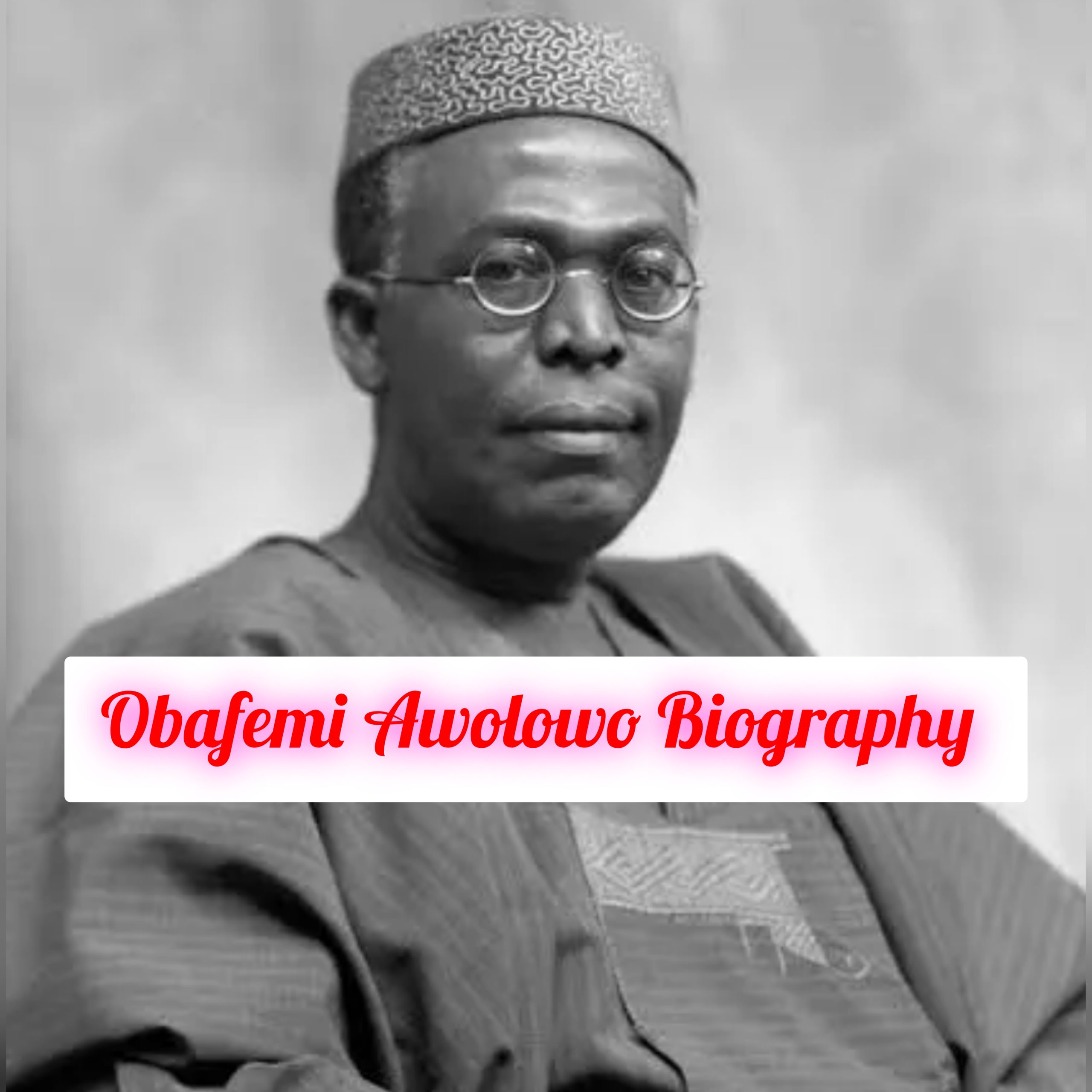
Obafemi Awolowo Biography: Early Life, Age, Personal Life, Career, Family, Education, Awards, Philosophy, Legacy, Death, Net Worth
Obafemi Awolowo Biography
Chief Obafemi Awolowo remains one of the most consequential figures in the political history of modern Nigeria. A lawyer, nationalist, administrator and thinker, he shaped the course of decolonisation, regional development and the debate over federalism in a multi-ethnic society. His ideas on social welfare, education and economic planning continue to influence public discourse decades after his death.
Born into modest circumstances in a small Yoruba town, he rose through determination, intellectual discipline and organisational skill to become Premier of the Western Region and a central actor in national politics. His career combined practical governance with a coherent political philosophy that placed the welfare of ordinary citizens at the centre of state action.
Jeremiah Obafemi Oyeniyi Awolowo was born in Ikenne, in what is now Ogun State, Nigeria. He was Nigerian by nationality.
Obafemi Awolowo Early Life
Obafemi Awolowo was born on 6 March 1909 in Ikenne, a town in the Remo area of present-day Ogun State. At the time of his birth the area formed part of the British Colony and Protectorate of Southern Nigeria. His father, David Sopolu Awolowo, was a farmer and sawyer who had converted to Christianity and belonged to a local chiefly lineage connected with the traditional Osugbo society. His mother was Mary Efunyela Awolowo. He was the only son and had two sisters together with one maternal half-sister.
The death of his father in April 1920, when Obafemi was about eleven years old, disrupted the family’s modest stability. Without a reliable source of support, the young Awolowo had to combine schooling with various forms of paid work. He fetched and sold firewood, served as a houseboy and took on farm labour and other odd jobs in order to continue his education. These early experiences of material hardship left a lasting mark on his outlook. They reinforced a lifelong conviction that individual effort, combined with opportunities created by the state, could overcome the limitations of birth.
His early schooling took place in mission institutions in Ikenne, Abeokuta and Ibadan. He attended St. Saviour’s School in Ikenne and later Imo Wesleyan School in Abeokuta. Periods of attendance alternated with stretches of work. Despite these interruptions he developed strong habits of self-study and a determination to acquire formal qualifications beyond the limited opportunities available in his hometown.
Obafemi Awolowo Personal Life
Awolowo married Hannah Idowu Dideolu Adelana on 26 December 1937 at St. Saviour’s Anglican Church in Ikenne. The marriage lasted until his death nearly fifty years later and was widely regarded as a partnership of unusual mutual support. Hannah Awolowo, often known as HID, managed family businesses and provided financial stability during periods when her husband devoted himself fully to politics or was imprisoned. Awolowo himself frequently acknowledged her role, describing her as a source of strength and describing the three pillars of his success as the grace of God, personal self-discipline and a good wife.
The couple maintained a monogamous household at a time when polygamy remained common among men of comparable social standing. Awolowo lived an austere personal life in later decades, avoiding alcohol and maintaining strict routines of work and study. He was a practising Christian of the Wesleyan Methodist tradition and combined religious faith with a rationalist approach to public policy.
Obafemi Awolowo Age
Obafemi Awolowo lived from 6 March 1909 until 9 May 1987. He died at the age of seventy-eight in his hometown of Ikenne. His death was widely mourned across Nigeria, including by political opponents who recognised the scale of his contribution to the country’s development.
Obafemi Awolowo Education
Formal education for Awolowo was neither continuous nor easy. After primary schooling in mission institutions he entered Wesley College in Ibadan, a teachers’ training institution, and completed his course there in 1927. He worked for a time as a teacher and later as a clerk at the same college while continuing private study.
Through correspondence he prepared for and obtained the Bachelor of Commerce degree as an external student of the University of London. In 1944 he travelled to Britain to study law. He was admitted to the Honourable Society of the Inner Temple and was called to the English Bar on 19 November 1946. The combination of commercial training and legal qualification equipped him both for professional practice and for the analytical approach he later brought to constitutional and economic questions.
His educational path illustrated the limited opportunities available to talented young Nigerians under colonial rule and strengthened his later insistence that the state must expand access to schooling as a matter of public policy.
Obafemi Awolowo Career
Early Professional Activities
After leaving Wesley College, Awolowo worked as a teacher in Abeokuta, qualified as a shorthand typist, and served as a clerk. He also worked as a correspondent for the Nigerian Times. He later entered business as a produce buyer and transporter based in Ibadan. These commercial activities provided income and also brought him into contact with traders, motor unions and produce associations. He held leadership positions in the Nigerian Motor Transport Union, the Nigerian Produce Traders’ Association and the Trades Union Congress of Nigeria. These organisational experiences developed his skills in mobilisation and administration.
Formation of Political Organisations
Awolowo became active in the Nigerian Youth Movement in the 1930s and rose to become secretary of its Western Provincial branch. While studying in London he founded the Egbe Omo Oduduwa in 1945 as a cultural organisation dedicated to the unity and advancement of the Yoruba people. The group was formally launched in Nigeria after his return. In 1949 he established the Nigerian Tribune, a newspaper that became an important platform for nationalist opinion and remains in publication today.
In 1951 he founded the Action Group as a political party. The party drew support from the cultural networks of the Egbe Omo Oduduwa and from progressive elements in the Western Region. Awolowo served as its first president. The Action Group contested the regional elections held under the new constitutional arrangements and emerged as the dominant party in the West.
Premiership of the Western Region
Following constitutional changes that created regional governments, Awolowo became Head of Government Business and later the first Premier of the Western Region, serving from 1954 until December 1959. His administration implemented an ambitious programme of social and economic development financed largely by the region’s cocoa revenue.
The most celebrated initiative was the introduction of free and compulsory primary education in January 1955. Enrolment rose sharply. Primary school numbers expanded from roughly 430,000 in the early 1950s to more than one million by the end of the decade. Secondary school enrolment and teacher training also increased substantially. The government awarded hundreds of scholarships for higher education each year. Free medical care for children up to the age of eighteen was introduced, and hospitals and clinics were expanded across the region.
Other measures included the establishment of a minimum wage higher than that paid in other regions, the creation of industrial and housing estates, agricultural settlements, and improved road and water infrastructure. In 1959 the Western Region launched the Western Nigeria Television service, the first television station in Africa. Liberty Stadium in Ibadan was constructed as a modern sports facility. Cocoa House, for a time the tallest building in tropical Africa, was completed in Ibadan. The regional civil service was Nigerianised and professionalised, earning a reputation for efficiency.
In December 1959 Awolowo resigned as Premier to contest a seat in the federal House of Representatives. He was succeeded in the Western Region by Samuel Ladoke Akintola.
Leader of the Opposition and Imprisonment
After independence in 1960 Awolowo led the Action Group as the official opposition in the federal parliament. Relations within the party deteriorated. A bitter dispute with Akintola over strategy and control of the regional government led to violence in the Western House of Assembly and the declaration of a state of emergency by the federal government in 1962.
In November 1962 Awolowo and several associates were charged with treasonable felony, conspiracy and related offences. The trial, which lasted many months, was highly contentious. Supporters regarded it as a political prosecution designed to remove the most effective opposition leader. In September 1963 he was convicted and sentenced to ten years’ imprisonment. He served part of the sentence in Calabar Prison. While in custody he wrote several works on constitutional and political questions. He was released after the military coup of January 1966.
Role in the Civil War
Following the outbreak of the Nigerian Civil War in 1967, General Yakubu Gowon appointed Awolowo Federal Commissioner for Finance and Vice-Chairman of the Federal Executive Council. He held these positions from 1967 until 1971. In this capacity he managed the federal economy under wartime conditions, maintained relative financial stability and oversaw the change of currency that limited the secessionist government’s access to foreign exchange. His role remains a subject of sharp debate, particularly among those from the former Eastern Region who associate federal economic measures with civilian hardship.
Later Political Career
With the return to civilian rule, Awolowo founded the Unity Party of Nigeria in 1978. The party’s programme emphasised free education at all levels, free health care, rural development and integrated economic planning. He contested the presidential elections of 1979 and 1983 but was unsuccessful. After the military intervention of December 1983 he retired from active party politics, though he continued to write and to comment on national affairs until his death.
Obafemi Awolowo Family
Awolowo and his wife Hannah had five children: Olusegun (born 1938 or 1939, died 1963), Omotola Oyediran (née Awolowo), Oluwole Awolowo, Ayodele Soyode (née Awolowo) and Tokunbo Awolowo-Dosunmu. The death of the eldest son, Olusegun, while Awolowo was in prison was a profound personal loss. Several of the children and their descendants remained active in public life, business and the management of family institutions, including the Nigerian Tribune and the Obafemi Awolowo Foundation.
Obafemi Awolowo Philosophy
Awolowo’s political thought combined democratic socialism, federalism and a strong emphasis on mental and moral discipline. He argued that Nigeria’s ethnic and cultural diversity made a federal system essential if unity was to be preserved on a just basis. Each region, he maintained, should possess substantial autonomy to develop according to its own resources and priorities while participating in a common national framework.
He placed education at the centre of development. In his view an educated population was both a right and the principal means of raising productivity and civic capacity. He advocated state investment in social services, limited public ownership in strategic sectors and careful economic planning. His writings stress the importance of integrity in public office, long-term thinking and the rejection of ethnic domination. He described his approach as democratic socialism and later as a philosophy of mental magnitude that linked personal self-discipline with collective progress.
These ideas were set out in a series of books that include Path to Nigerian Freedom (1947), Awo: The Autobiography of Chief Obafemi Awolowo (1960), Thoughts on Nigerian Constitution (1966), The People’s Republic, Strategy and Tactics of the People’s Republic of Nigeria, and collections of speeches published under titles such as Voice of Reason, Voice of Courage and Voice of Wisdom.
Obafemi Awolowo Achievements
As Premier of the Western Region Awolowo supervised the most comprehensive programme of social development undertaken in any part of colonial or early independent Africa. Free primary education and free health care for children transformed access to opportunity for hundreds of thousands of families. The establishment of the first television service in Africa, the construction of modern infrastructure and the professionalisation of the regional civil service set standards that other regions sought to emulate.
At the national level he contributed to the constitutional debates that shaped independent Nigeria, provided economic management during the Civil War and sustained a coherent alternative vision of governance through successive military and civilian regimes. His newspaper, the Nigerian Tribune, remains an enduring institution. The University of Ife was renamed Obafemi Awolowo University in his honour. His portrait appears on the one-hundred-naira banknote. He is widely remembered as the first modern leader of the Yoruba people and as a statesman whose influence exceeded the formal offices he held.
Obafemi Awolowo Awards
In 1982 the Federal Government of Nigeria conferred on him the Grand Commander of the Order of the Federal Republic, the country’s highest honour. He received honorary degrees from several universities, including the University of Nigeria, Nsukka (LL.D., 1962), the University of Ife (D.Sc., 1967) and the University of Lagos (D.Litt., 1968). He held numerous traditional chieftaincy titles, among them the Asiwaju of Yorubaland, Losi of Ikenne, Lisa of Ijeun and Odofin of Owo. Foreign governments, including those of Liberia and Senegal, also conferred honours upon him.
Obafemi Awolowo Legacy
Awolowo’s legacy rests on two foundations: concrete achievements in government and a body of ideas that continue to structure Nigerian political debate. The free education programme of the Western Region produced generations of professionals whose skills strengthened the region’s economy and public life. His insistence on federalism based on cultural and linguistic affinity remains a reference point in discussions of constitutional reform. Admirers often describe him as the best president Nigeria never had, a phrase that captures both the scale of his vision and the fact that he never held the highest national executive office.
Criticism of his career centres on the ethnic character of the Action Group, the political crisis of the early 1960s and the economic measures adopted during the Civil War. These controversies have not erased recognition of his administrative competence or the seriousness of his intellectual contribution. Institutions bearing his name, annual commemorations and the continued circulation of his writings keep his thought present in public life.
Conclusion
Obafemi Awolowo combined personal discipline, organisational talent and a coherent social philosophy to leave an imprint on Nigeria that few of his contemporaries matched. From the hardships of a fatherless childhood in Ikenne he rose to become a barrister, a regional premier, a wartime finance commissioner and a perennial opposition leader. His most tangible successes lay in the expansion of education and health services in the Western Region and in the demonstration that purposeful government could improve the lives of ordinary citizens within a generation. His writings on federalism, socialism and mental magnitude continue to offer a framework for thinking about Nigeria’s persistent challenges. Though he never occupied the presidency, his ideas and example remain central to any serious assessment of the country’s modern history.
FAQs
Who was Obafemi Awolowo?
Obafemi Awolowo was a Nigerian lawyer, nationalist and statesman who served as the first Premier of the Western Region from 1954 to 1959 and later as Federal Commissioner for Finance during the Nigerian Civil War. He founded the Action Group and the Unity Party of Nigeria and is widely regarded as one of the principal architects of modern Nigeria.
When and where was Obafemi Awolowo born?
He was born on 6 March 1909 in Ikenne, in present-day Ogun State, Nigeria.
What is Obafemi Awolowo best known for?
He is best known for introducing free primary education and free health care for children in the Western Region, establishing the first television station in Africa, and advocating a federal system of government suited to Nigeria’s diversity.
Who was Obafemi Awolowo’s wife?
He was married to Hannah Idowu Dideolu Awolowo, popularly known as HID Awolowo, from 1937 until his death in 1987.
Did Obafemi Awolowo become President of Nigeria?
No. He contested the presidential elections of 1979 and 1983 under the Unity Party of Nigeria but did not win. He is often described as the best president Nigeria never had.
What books did Obafemi Awolowo write?
His principal works include Path to Nigerian Freedom (1947), Awo: The Autobiography of Chief Obafemi Awolowo (1960), Thoughts on Nigerian Constitution (1966), The People’s Republic, Strategy and Tactics of the People’s Republic of Nigeria, and several collections of speeches.
When did Obafemi Awolowo die?
He died on 9 May 1987 in Ikenne at the age of seventy-eight.
What is the significance of free education in Awolowo’s career?
The free primary education scheme launched in the Western Region in January 1955 dramatically expanded school enrolment and is widely regarded as one of the most successful social programmes in the history of independent Africa.