Samora Machel Biography: Age, Early Life, Personal Life, Education, Family, Career, Awards, Philosophy, Achievements, Legacy, Death, Net Worth
Samora Machel Biography
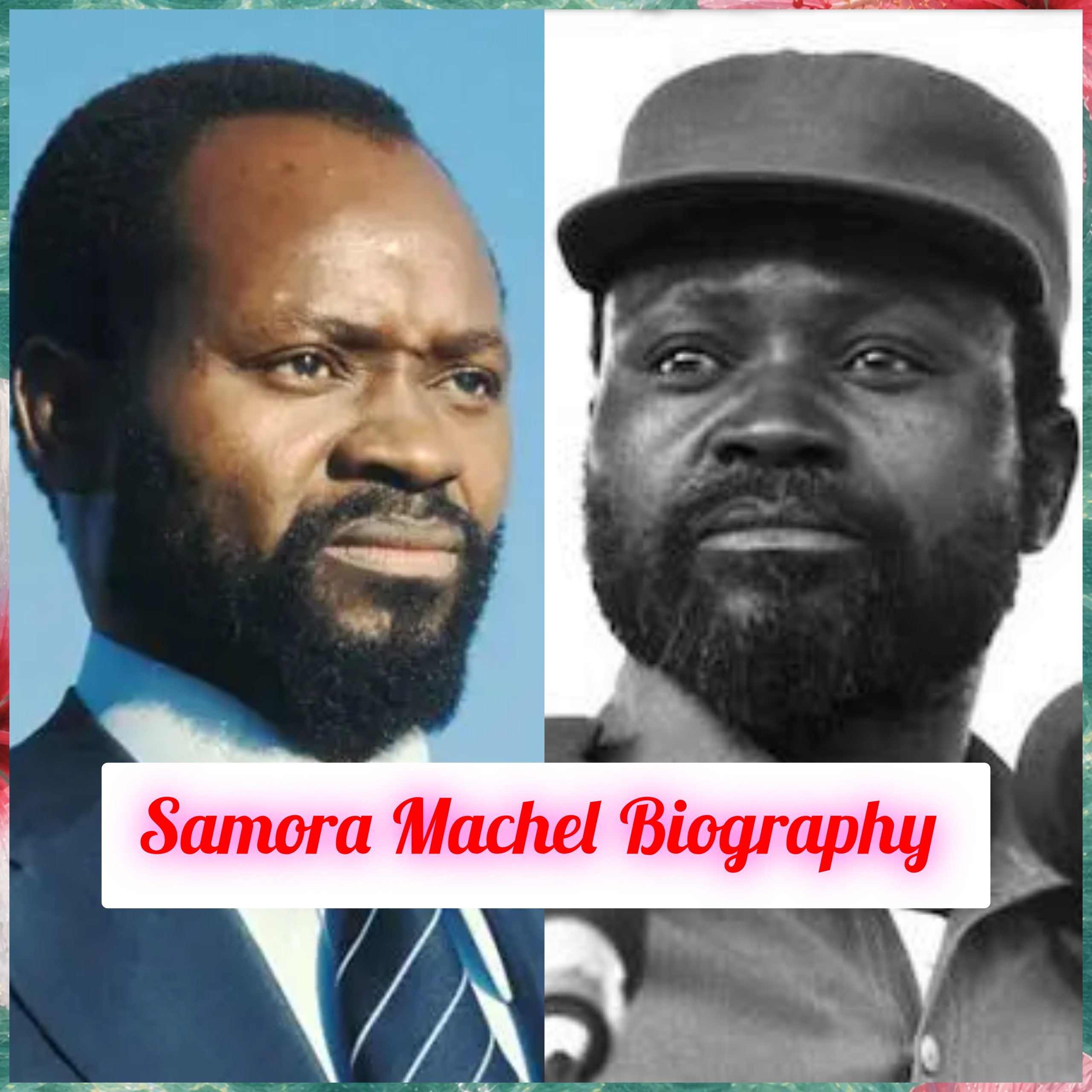
Samora Moisés Machel known as one of the central figures in the modern history of southern Africa. As a nurse who became a guerrilla commander and then the first president of independent Mozambique, he guided his country through the final phase of the struggle against Portuguese colonial rule and into the early years of nation building under a socialist vision. His leadership combined military discipline with a strong commitment to social transformation, leaving a lasting imprint on Mozambique and the broader region.
Machel’s life reflected the harsh realities of colonial Mozambique and the determination of a generation that sought not only political independence but also a fundamental restructuring of society. From rural origins in Gaza Province to the presidency, his path was shaped by personal experience of discrimination, the influence of African liberation movements, and a firm belief in collective progress.
Samora Moisés Machel was born in Chilembene (then known as Madragoa), Gaza Province, Mozambique, and was Mozambican by nationality.
Samora Machel Early Life
Samora Moisés Machel was born on 29 September 1933 in the village of Chilembene, located in the Chokwe District of Gaza Province in southern Mozambique. The area lies in the fertile Limpopo River valley, where his family worked the land as peasant farmers belonging to the Shangana ethnic group. His parents were Mandande Moisés Machel and Guguiye Thema Dzimba. The family lived under the strict racial and economic restrictions of Portuguese colonial rule, which classified most Africans as “indígena” and subjected them to forced labor, lower prices for crops, and limited rights.
Portuguese authorities required African farmers to grow cotton for export rather than food crops for their own use. This policy created hardship and food insecurity. In the 1950s the family’s farmland was taken and given to Portuguese settlers, forcing relatives to seek work in the South African mines under dangerous conditions. One of Machel’s brothers later died in a mining accident. These experiences left a deep mark and contributed to Machel’s later political outlook.
Education opportunities for African children were severely restricted. Machel attended Catholic mission schools, the main avenue available, even though his family had Protestant roots. He converted to Catholicism in order to continue his studies. He completed only a limited primary education and never finished secondary school because colonial policy largely barred Africans from higher levels of formal learning. Despite these obstacles he developed a strong desire to learn and later trained as a nurse, one of the few skilled professions open to Black Mozambicans at the time.
Samora Machel Personal Life
Machel’s personal life was closely intertwined with the liberation struggle and the demands of leadership. He was known for a disciplined lifestyle. He neither drank nor smoked and preferred a relatively modest existence even after becoming president. Contemporaries described him as charismatic, articulate, and capable of connecting with ordinary people through plain language and direct speech.
His relationships reflected the mobility and instability of revolutionary life. In the late 1950s, while working as a nurse on Inhaca Island and later in Lourenço Marques (now Maputo), he formed a relationship with Sorita Tchaiakomo. They had several children together. He also had a daughter with another nurse, Irene Buque. These early family ties were interrupted when he left the country to join the liberation movement.
In May 1969 he married Josina Abiatar Muthemba, a dedicated FRELIMO cadre and women’s rights advocate within the movement. Their marriage was short. Josina died of leukemia in 1971 at the age of 26, a loss that deeply affected Machel. In September 1975, three months after independence, he married Graça Simbine, a teacher and FRELIMO member who became Minister of Education and Culture. Their marriage lasted until his death in 1986. Graça later married Nelson Mandela and became known internationally for humanitarian work.
Machel maintained a strong sense of family responsibility. After independence he brought his older children into the presidential household, where they were raised alongside the children from his marriage to Graça. He valued collective life and often spoke of the need to build a new society free from the divisions of the colonial past.
Samora Machel Age
Samora Machel was born on 29 September 1933 and died on 19 October 1986. He was 53 years old at the time of his death in a plane crash near Mbuzini, South Africa.
Samora Machel Education
Formal education for Africans in colonial Mozambique was tightly controlled and largely limited to mission schools. Machel attended Catholic mission schools in the Gaza region. He completed primary education under difficult conditions and later moved to the capital, then called Lourenço Marques, to train as a nurse. Nursing was one of the higher-status occupations available to Black Mozambicans.
He studied at the Miguel Bombarda Hospital nursing school in the mid-1950s. While working as a nurse he continued some private secondary studies at night, financed by his own earnings. He never completed a full secondary or university education. The colonial system deliberately restricted advanced schooling for the African majority, and Machel’s path reflected those structural barriers. His practical experience in the hospital, where he observed stark inequalities in pay and treatment between Black and white staff, proved more formative than formal classrooms. This period radicalized him and prepared the ground for his later political commitment.
Samora Machel Career
Nursing and Early Political Awareness
Machel worked as a nurse for roughly a decade, first on Inhaca Island and later at Miguel Bombarda Hospital in Lourenço Marques. In the hospital he saw the unequal treatment of African patients and the lower wages paid to Black nurses compared with their white counterparts. He began to speak out against these injustices. The experience convinced him that colonial rule could not be reformed from within and that organized resistance was necessary.
Joining FRELIMO and Military Training
In 1962 the Front for the Liberation of Mozambique (FRELIMO) was founded in Dar es Salaam, Tanzania, under the leadership of Eduardo Mondlane. Machel left Mozambique in 1963 to join the movement. He received military training in Algeria, one of the centers for African liberation fighters at the time. Upon returning to the FRELIMO base in Tanzania he helped train guerrilla fighters.
On 25 September 1964 FRELIMO launched its first armed attacks in northern Mozambique, beginning the decade-long war of independence. Machel participated in these early operations and quickly demonstrated organizational skill and leadership in the field. He spent long periods with the fighters, sharing their hardships and insisting on strict discipline and political education.
Rise Within FRELIMO
In 1966 Machel became Secretary of Defense. After the death of the previous military commander, Filipe Magaia, he assumed overall command of the guerrilla forces. When Eduardo Mondlane was assassinated by a parcel bomb in February 1969, FRELIMO faced a leadership crisis. A temporary presidential council was formed, and in May 1970 Machel was elected president of the movement. Under his leadership FRELIMO expanded its liberated zones, improved internal discipline, and intensified military pressure on Portuguese forces.
Negotiations and Independence
The Carnation Revolution in Portugal on 25 April 1974 changed the political landscape. The new Portuguese government sought to end the colonial wars. Machel led FRELIMO in negotiations that produced the Lusaka Agreement of September 1974. The agreement set 25 June 1975 as the date for independence and provided for a transitional government in which FRELIMO held the majority of ministerial posts.
On 25 June 1975 Mozambique became independent. Samora Machel was sworn in as the first president of the People’s Republic of Mozambique. He remained in office until his death in 1986.
Presidency and Domestic Policy
As president, Machel pursued a socialist program. The government nationalized land, key industries, banks, health services, and education. Free primary education and expanded rural health clinics produced rapid early gains in literacy and access to basic medical care. Communal villages were established in an attempt to reorganize rural production and deliver social services more efficiently. FRELIMO was transformed into a Marxist-Leninist vanguard party at its Third Congress in 1977.
These policies faced serious obstacles. The mass departure of Portuguese settlers, skilled workers, and capital created economic disruption. The civil war that developed with the Mozambican National Resistance (RENAMO), initially backed by Rhodesia and later by apartheid South Africa, inflicted heavy damage on infrastructure and agriculture. Drought and the global economic climate of the late 1970s and early 1980s compounded the difficulties.
Regional Role and Foreign Policy
Machel positioned Mozambique as a frontline state against white minority rule in southern Africa. The country provided bases and support to the African National Congress and to Zimbabwean liberation movements. After Zimbabwe’s independence in 1980, pressure from South Africa intensified. In March 1984 Machel signed the Nkomati Accord with South Africa, under which each side agreed not to support the other’s opposition forces. Implementation proved incomplete, and the civil war continued.
Machel maintained close ties with socialist countries while also seeking practical relations with Western nations. He was a strong voice in the Non-Aligned Movement and consistently condemned apartheid as a system that could not be reformed but had to be dismantled.
Samora Machel Family
Machel came from a rural farming family with a history of resistance. His grandfather Malengani had fought alongside Ngungunyane, the last ruler of the Gaza Empire, against Portuguese forces in the late nineteenth century. Stories of this resistance formed part of Machel’s early political education.
He had children from several relationships. With Sorita Tchaiakomo he had Joscelina, Idelson (or Edelson), Olívia, and N’tewane. With Irene Buque he had a daughter, Ornila. With Josina Muthemba he had a son, Samito. With Graça Simbine he had a daughter, Josina (born 1976), and a son, Malengane (born 1978). After independence the older children joined the presidential household and were raised together. Graça Machel later assumed primary responsibility for the extended family following Samora’s death.
Samora Machel Philosophy
Machel’s political philosophy developed from lived experience rather than abstract study. He often stated that his radical views originated in the discrimination suffered by his family under Portuguese rule, not from reading Marxist texts. He nevertheless adopted Marxism-Leninism as the framework that best explained colonial exploitation and offered a path to a society without class or racial domination.
He emphasized that the armed struggle must become a social revolution. Political independence alone was insufficient; a new mentality and new social relations had to be built. Education, production, and combat were linked in the FRELIMO slogan “study, produce, and fight.” He insisted that leadership must be collective and that the state must serve the people rather than a privileged elite.
Machel rejected tribalism and regionalism, arguing that national unity required transcending older loyalties. He also rejected racial essentialism, stating that the enemy was the system of exploitation, not people of a particular color. His speeches frequently stressed the need for discipline, hard work, and the rejection of both colonial and traditional forms of exploitation.
Samora Machel Achievements
Machel’s most enduring achievement was leading Mozambique to independence after nearly five centuries of Portuguese rule. As military commander and later president of FRELIMO he unified the movement, expanded liberated zones, and negotiated the terms of independence from a position of strength.
In the early years of independence his government made measurable progress in expanding access to education and health care. Literacy campaigns and the construction of rural clinics reached communities that had been largely ignored under colonialism. Land nationalization and the creation of state farms and cooperatives aimed to reverse colonial patterns of land ownership, though results were mixed.
Regionally, Machel’s support for liberation movements in Zimbabwe and South Africa contributed to the eventual end of white minority rule in those countries. His insistence that apartheid could not be reformed helped shape international opinion. Despite the economic and military difficulties of the 1980s, he remained a symbol of principled resistance for many across the continent.
Samora Machel Awards
Samora Machel received several international honors in recognition of his role in the liberation struggle and his contributions to peace and anti-colonial solidarity. He was awarded the Lenin Peace Prize for the period 1975–1976. Other decorations included the Order of José Martí and the Order of Playa Girón from Cuba, the Order of Friendship of Peoples from the Soviet Union, the Order of the Uhuru Torch of Mount Kilimanjaro (First Class) from Tanzania, the Grand Collar of the Order of Prince Henry from Portugal, the Knight Grand Cross with Collar of the Order of Merit of the Italian Republic, and the Order of the National Flag (First Class) from North Korea. He also received high decorations from Zambia.
Samora Machel Legacy
Machel’s death on 19 October 1986, when the presidential Tupolev Tu-134 crashed in the Lebombo Mountains near Mbuzini, South Africa, remains the subject of debate. Official South African investigations attributed the crash to pilot error, while Mozambican and Soviet authorities suspected the plane had been deliberately diverted by a false navigational beacon. The circumstances have never been fully resolved to the satisfaction of all parties.
His legacy is complex. He is remembered as the founder of independent Mozambique and a committed revolutionary who sought to build a more equal society. At the same time, the authoritarian character of one-party rule, the economic costs of rapid nationalization, and the prolonged civil war form part of the historical record. Streets, schools, bridges, and public institutions across Mozambique and neighboring countries bear his name. His speeches continue to be studied for their clarity of purpose and their insistence that true independence requires social transformation.
Conclusion
Samora Moisés Machel rose from a rural colonial background to lead Mozambique through armed struggle and into independence. His presidency sought to translate the ideals of the liberation war into practical policies of social equality, national unity, and regional solidarity. Although economic hardship and civil conflict limited the full realization of his vision, his role in ending Portuguese rule and his commitment to a transformed society remain central to Mozambique’s modern history. He left office only through death, and his memory continues to shape national identity and regional discussions of liberation and justice.
FAQs
Who was Samora Machel?
Samora Moisés Machel was a Mozambican revolutionary, military commander, and statesman who led the FRELIMO liberation movement and served as the first president of independent Mozambique from 1975 until his death in 1986.
When and where was Samora Machel born?
He was born on 29 September 1933 in the village of Chilembene (then Madragoa) in Gaza Province, southern Mozambique.
What was Samora Machel’s role in Mozambique’s independence?
He joined FRELIMO in 1963, rose to become its military commander and later its president, and led the movement through the final years of the war against Portuguese rule. He became the first president upon independence on 25 June 1975.
How did Samora Machel die?
He died on 19 October 1986 when the presidential aircraft crashed in the Lebombo Mountains near Mbuzini, South Africa, while returning from a meeting in Zambia. The exact cause remains disputed.
What was Samora Machel’s political ideology?
He was a Marxist-Leninist who believed that national liberation must be accompanied by social and economic transformation aimed at eliminating exploitation and building collective prosperity.
Who was Samora Machel married to?
He was married to Josina Muthemba from 1969 until her death in 1971, and to Graça Simbine from 1975 until his own death in 1986. He also had children from earlier relationships.
What awards did Samora Machel receive?
Notable awards include the Lenin Peace Prize (1975–1976), Cuban decorations (Order of José Martí and Order of Playa Girón), the Soviet Order of Friendship of Peoples, and high national honors from Tanzania, Zambia, Portugal, Italy, and North Korea.